
The assumption that Large Language Models will eventually replace entire teams is one of the most persistent and costly misconceptions in enterprise AI adoption today. Research in organizational settings supports the view that generative AI acts as a "cybernetic teammate," improving collaborative outcomes rather than simply displacing human contributors. The teams that are pulling ahead right now are not the ones that swapped out people for AI. They are the ones that figured out how to combine both.
Key Takeaways
| Point | Details |
|---|---|
| LLMs amplify winning teams | Teams using LLMs outperform both solo workers and traditional teams without replacing anyone. |
| Boost throughput, not teamwork | LLMs drive more output but do not automatically improve communication or trust. |
| Redesign for synergy | Leaders gain the most when they intentionally align team processes with LLM strengths. |
| Human oversight remains critical | Ongoing human checkpoints and quality control ensure reliable outcomes with LLM-augmented teams. |
| Start with team strengths | Build your LLM strategy around enhancing, not replacing, your team's unique capabilities. |
Why LLMs Don't Replace Teams - The Evidence
The numbers are hard to argue with. Teams using AI produced top-10% ideas at roughly three times the rate compared to individuals working without AI, based on a study of 791 product developers at Procter & Gamble. That is not a marginal improvement. That is a structural advantage.
Large-scale field experiments also confirm that AI copilots increase knowledge-work throughput rather than requiring wholesale replacement of teams. The productivity gains show up in volume, speed, and quality of output, not in headcount reduction.
| Configuration | Idea quality (top 10%) | Speed of output | Scalability |
|---|---|---|---|
| Human team, no AI | Baseline | Baseline | Limited |
| Solo individual with LLM | Moderate gain | High | Moderate |
| Team with LLM integrated | ~3x baseline | Very high | High |
The pattern is consistent across industries. Teams that integrate LLMs into structured workflows outperform both solo AI users and human-only groups. You can see this dynamic play out in our machine learning case studies, where collaborative AI integration consistently drives stronger outcomes than point-solution automation.
Key finding: Teams using AI produced top-10% ideas at approximately 3x the rate of individuals working without AI, demonstrating that LLMs amplify collective intelligence rather than replace it.
What makes this finding particularly important for decision-makers is the directionality. The gains are not from AI working alone. They are from AI working inside a team structure, with human judgment shaping the process at every critical stage. Explore how local LLM deployment can support this kind of structured integration in secure, enterprise-grade environments.
How Top Teams Actually Use LLMs
Understanding the data is one thing. Translating it into daily team operations is another. The mechanics leaders can use involve treating AI as an augmenting teammate inside workflows while explicitly managing collaboration boundaries and quality gates.
Here is a practical, step-by-step model that high-performing teams are using right now:
- Map existing workflows. Before introducing an LLM, document where your team's time actually goes. Identify tasks that are repetitive, drafting-heavy, or research-intensive. These are your highest-value LLM insertion points.
- Assign the LLM a defined role. Give the model a specific function, such as first-draft generation, competitor research synthesis, or meeting summary production. Ambiguous roles produce ambiguous results.
- Build human checkpoints into the process. Every LLM output should pass through a human review stage before it influences decisions, client deliverables, or team direction. This is non-negotiable.
- Iterate based on output quality. Track where LLM contributions accelerate work versus where they require heavy editing. Adjust the model's role accordingly over time.
- Scale what works. Once a workflow is validated, replicate it across other team functions using the same structured approach.
This kind of disciplined integration is central to how we approach AI development workflow guidance for clients across sectors. The goal is never to automate everything. It is to automate the right things so your team can focus on the work that actually requires human expertise.
Pro Tip: Assign your LLM a team "persona" with defined responsibilities and explicit limits. For example, "This model handles first drafts and research summaries. All client-facing content requires human review before sending." This simple framing reduces overreliance and keeps quality gates visible to the whole team.
The AI in marketing teams context illustrates this well. Marketing teams that assign LLMs to content ideation and copy drafting while keeping brand strategy and audience judgment with senior staff consistently outperform teams that either avoid AI entirely or let it run without oversight.
Throughput, Not Teamwork: What LLMs Really Impact
Here is where many leaders make a critical error. They deploy LLMs expecting them to fix team culture, improve trust, or resolve communication breakdowns. They do not.
AI adoption increases throughput within teams while leaving core collaboration dynamics unchanged. This is actually a useful clarification, because it tells you exactly where to focus your expectations.
| Metric | Impact with LLM integration |
|---|---|
| Content output volume | Significant increase |
| Research and synthesis speed | High improvement |
| First-draft turnaround | Dramatically faster |
| Team trust and communication | No direct change |
| Organizational culture | No direct change |
| Decision-making quality | Improves with human oversight |
What LLMs do change:
- Volume and speed of written outputs
- Quality of brainstormed options when used in ideation sessions
- Consistency of documentation and reporting
- Ability to process and summarize large volumes of information quickly
What LLMs do not change:
- Whether your team communicates openly and honestly
- Whether leadership makes sound strategic decisions
- Whether people feel psychologically safe enough to flag problems
- Whether your organizational values are actually practiced
This distinction matters enormously. If your team has trust issues, deploying an LLM will give you faster outputs from a team that still has trust issues. The advanced AI search applications we build at Silk Data are powerful, but they are designed to support teams that already have functional processes. They are not a substitute for those processes.
For teams investing in capability development, employee training with AI offers a practical path to building the skills people need to work effectively alongside LLMs, without assuming the technology will do the cultural work for them.
Redesigning Teams for LLM-Powered Wins
Once you accept that LLMs improve throughput but not team dynamics, the next question becomes: what do you do with the time you save?
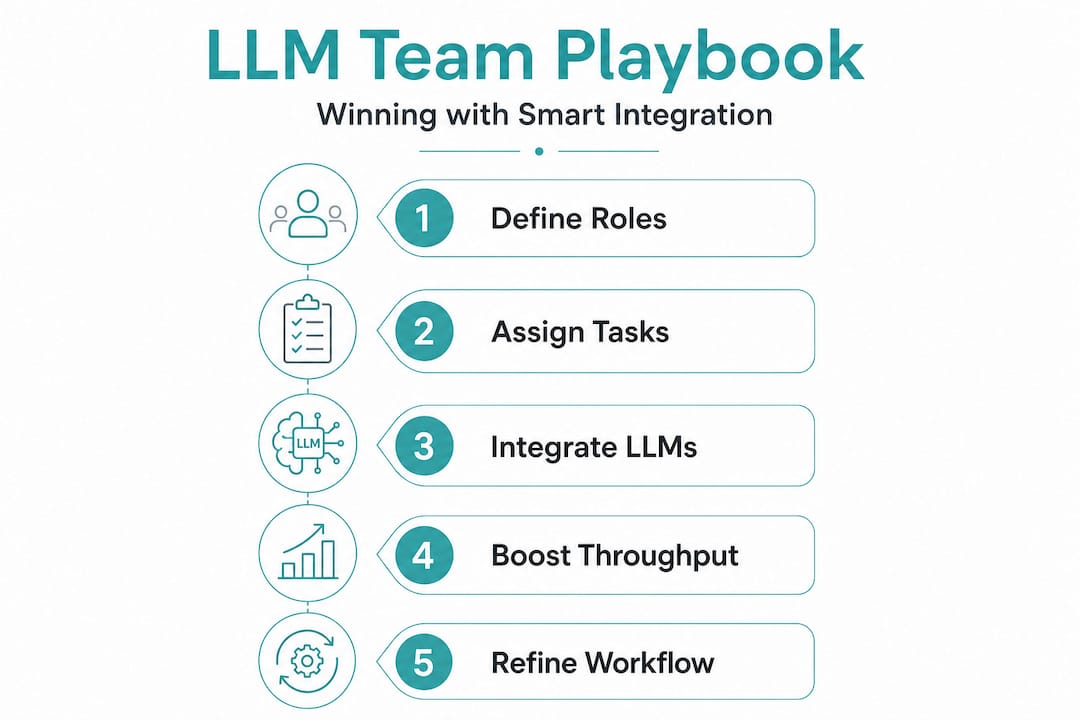
Teams should reallocate time saved via LLMs toward judgment-heavy work, coordination design, and customer value. That is where the real competitive advantage lives.
Here is a practical redesign framework:
- Audit current time allocation. Quantify how much team time goes to drafting, formatting, summarizing, and routine coordination. These are your LLM candidates.
- Identify your highest-judgment activities. Strategic planning, client relationship management, product direction, and complex problem-solving all require human expertise. Protect time for these.
- Reassign reclaimed hours explicitly. Do not let saved time disappear into ad hoc tasks. Formally redirect it toward the judgment-heavy work you identified.
- Redesign coordination structures. With LLMs handling routine information flow, your team meetings and check-ins can shift from status updates to strategic discussion.
- Measure and adjust quarterly. Track whether reclaimed time is actually being spent on higher-value work. If not, investigate why and recalibrate.
Pro Tip: Eliminate low-value coordination tasks first. Status update emails, meeting recaps, and routine reporting are prime candidates for LLM automation. Removing these frees your team for the work that genuinely requires human judgment.
The majority of value from LLMs comes to teams that pair AI with judgment, not automation alone. The technology amplifies what your team is already good at. It does not manufacture capability that was not there before.
The Real Reason Your Team Wins With LLMs - Hard Truths From the Field
Most organizations approach LLM adoption as a technology problem. They evaluate models, configure tools, and run pilots. What they underinvest in is the process and culture side of the equation.
The teams that win with LLMs are not the ones with the most sophisticated models. They are the ones that redesigned their workflows to take advantage of what LLMs actually do well, while doubling down on the human capabilities that AI cannot replicate.
Overreliance on LLMs without process redesign is one of the fastest routes to mediocre outcomes. You end up with faster mediocrity instead of better work. The output volume increases, but the quality ceiling stays exactly where it was before, because no one changed how decisions get made or how judgment gets applied.
The empirical expectation for decision-makers is clear: start with throughput gains, then reallocate time toward judgment. Do not assume AI will fix team quality alone. That assumption is where most LLM deployments stall out.
The biggest gains go to leaders who treat LLM integration as a structural redesign project, not a software rollout. They ask: "What does our team need to be exceptional at, and how does AI free us to do more of that?" That question leads somewhere. "How do we automate our team?" leads nowhere useful.
Stay current with practical lessons and case-based insights on our AI adoption blog, where we regularly share what is working across industries.
Partner With LLM Experts for Your Next Team Win
If this article has shifted how you think about LLMs and team performance, the next step is seeing these principles applied in real deployments.
Silk Data has spent over a decade helping organizations across education, finance, marketing, and retail build AI-powered workflows that actually deliver. Our team of more than 65 full-time engineers brings both technical depth and strategic clarity to every engagement. Whether you are exploring your first LLM integration or scaling an existing deployment, our AI development services are built to match your team's specific goals. Browse our machine learning case studies to see how teams like yours have turned LLM adoption into measurable competitive advantage. Let's work on your next project together.