
Modern TTS audio is no longer obvious. Neural systems now produce narration that a casual listener takes for a human recording. That changes the question. The real question is which provider fits your data, your languages, and your compliance perimeter. And which one won't lock you into a model you can't control.
This guide walks through how the technology works and how the main providers differ. It covers the real trade-offs: cloud vs on-prem, voice cloning vs licensed voices, free tiers vs commercial rights. Numbers and cases are sourced. Where we have built something similar, we say so.
How Text to Speech AI Services Work
A modern TTS system is a neural network trained on thousands of hours of recorded speech. It learns intonation, rhythm, and emphasis. Then it maps text to audio at runtime. The result reads as speech, not as a sequence of words.
Three technical levers matter in practice:
- Voice cloning. Short audio samples - often under a minute - are enough to produce a usable clone. Useful for brand consistency. Risky without consent.
- Expressive markup. SSML-style (Speech Synthesis Markup Language) tags for pauses, emphasis, and pace. They are the difference between an audiobook chapter and a flat read-through.
- Where inference runs. Cloud APIs give you the largest voice catalogues. On-device or on-prem models keep text inside your network. That is the only realistic option when input contains patient data, contract drafts, or unreleased product copy.
Comparing Popular Text to Speech Services
No single provider wins on every axis. The right choice depends on language coverage, integration target, data policy, and whether you can host the model yourself.
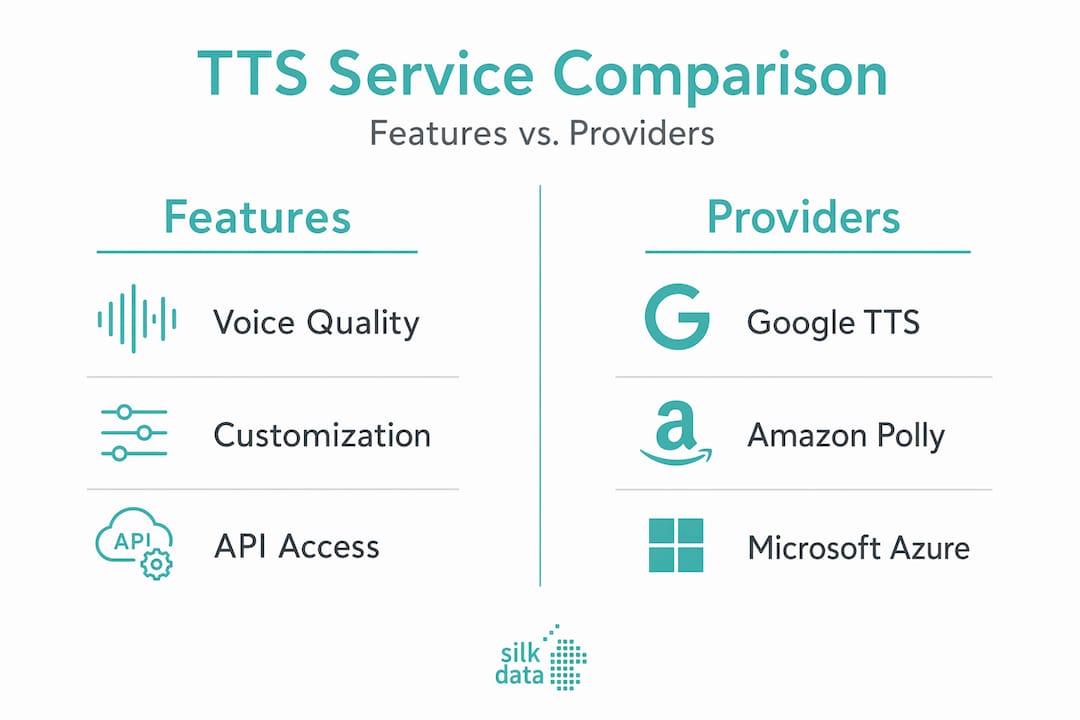
| Service | Best for | Deployment | Strength | Watch out for |
|---|---|---|---|---|
| Google Cloud TTS | Multilingual products | Cloud | 40+ languages, WaveNet voices | Per-character billing scales fast at podcast volume |
| Amazon Polly | AWS-native workflows | Cloud | Direct Lambda / S3 integration | Voice realism trails ElevenLabs for long-form narration |
| Microsoft Azure Speech | Enterprise with custom voice | Cloud + container | Custom Neural Voice, container deployment for regulated data | Custom voice approval is a gated process |
| ElevenLabs | Audiobooks, expressive narration | Cloud | Best-in-class prosody and cloning | Commercial licence tiering; review training-data clauses |
| Open-source (Coqui, Piper, XTTS) | On-prem, regulated data | Self-host | Full control, no data leaves your network | You own the MLOps, the voice quality, and the patches |
Four checks worth running before you sign:
- Language and accent coverage. Headline language counts hide quality gaps. A provider may list 40 languages and only 8 of them sound native.
- Data policy. Some providers reserve the right to use input text or audio for model training. For regulated content this is a hard stop.
- Commercial rights. Free tiers rarely include broadcast or paid-product distribution. Read the licence, not the landing page.
- Latency. Conversational use cases (IVR, voice agents) need sub-300ms time-to-first-audio. Many high-quality cloud voices don't hit that.
If none of the off-the-shelf options fit, hosting an open-source model on your own infrastructure is a real path. We used the same pattern for a marketing agency that wanted an LLM inside its own platform. The result: data security, predictable cost, full control of the model. See the on-prem LLM case for the trade-offs.
Where TTS Actually Pays Off
TTS earns its place when it removes a real bottleneck. Most other uses are nice-to-have. Five applications we see consistently work:
- Accessibility. Screen readers and reading-support tools for users with visual impairments or dyslexia. Under EU accessibility rules (EAA), public-sector and many private digital services must be reachable by assistive technology. TTS is part of that toolkit.
- Content pipelines at volume. Publishers and course producers turn long articles into audio without studio time. Pairs well with summarization - the same kind of pipeline we built for the Reemers publishing house, where a local LLM works on archives spanning years.
- IVR and voice agents. Consistent brand voice across phone, app, and web. Real risk: a bad TTS voice in IVR erodes trust faster than a slow human.
- Internal training audio. Compliance training, onboarding, product walkthroughs. Cheap to update when policy changes.
- Healthcare and education read-aloud. Patient instructions in multiple languages; reading support for students. On-prem is usually the right deployment here. The data is sensitive and the use case is recurring.
What rarely pays off: replacing a known voice in marketing without testing audience reaction first, or cloning a real employee's voice for IVR without a documented consent and exit process.
Cost-benefit reality check. A common trap is replacing studio narration for marketing content with TTS to save budget. At small volumes (under 30 minutes of audio per month), the savings rarely cover the time spent on prompt engineering, pronunciation tuning, and listener testing. Studio narration remains cost-effective below that threshold; TTS pays off when monthly volume crosses into the hours-per-month range, especially when content updates frequently.
Privacy, Security, and Compliance
TTS looks like a low-risk technology. It isn't, once you put real data through it. Three angles to think about separately - don't mix them.
Data handling (technical). Cloud TTS sends your text - and sometimes your reference audio - to a third party. On-prem TTS keeps it inside your network. For patient notes, legal drafts, or unreleased financial figures, on-prem is the default. Containerised options (Azure, self-hosted open-source) bridge the gap when your team isn't ready to run pure on-prem.
Personal data (legal, EU/UK). A voice that identifies a person is personal data under GDPR. Cloning it requires a lawful basis, typically explicit consent. The UK's ICO has published guidance classifying voice as biometric personal data when used to identify an individual, with corresponding consent and DPIA obligations. If you clone an employee's voice for IVR and they leave the company, you need a documented retraction and deletion process. Build that before the pilot, not after.
AI system classification (legal, EU). Under the EU AI Act, voice generation used in ways that could deceive a natural person falls under transparency obligations. The user must be informed they are interacting with AI-generated content. This is not optional for EU deployments.
For US contexts, NIST AI RMF gives a voluntary framework for risk management of generative systems. For US education products, FERPA constrains how student voice or text data can be processed by third parties.
Polina Volodina, AI Advisor at Silk Data, on scoping: "Before the technical PoC, we map three things. What data the model will see, which jurisdiction the users are in, and who owns the resulting audio. If any of those three is unclear, the PoC is premature."
Voice Cloning: The Honest Version
Voice cloning is the feature that sells TTS today. It's also the one that breaks first in production.
Where it works:
- Consistent brand voice across channels, with a licensed actor and a written agreement.
- Localisation of existing narrators into languages they don't speak, with their consent.
- Internal use - training, internal comms - with employee consent and a deletion clause.
Where it goes wrong:
- Cloning a public figure or competitor's spokesperson. This is a fast route to a lawsuit and, in several jurisdictions, criminal exposure.
- Cloning an employee without a written agreement covering use after they leave.
- Using a free-tier cloned voice in paid distribution without checking the licence.
A workable rule: treat a cloned voice the same way you'd treat a signed contract with the original speaker. If you wouldn't have them sign one, don't clone them.
How to Pilot TTS Without Wasting Three Months
A useful pilot is short, narrow, and measurable. The shape we recommend, drawn from how we run AI proofs of concept:
- One use case, one language, one channel. Don't test "TTS" - test "German product-update narration for our podcast feed".
- Real content, not demos. Run your hardest paragraph through every candidate. Pronunciations of proper nouns, numbers, and acronyms will expose weak voices fast.
- Two or three providers, side by side. Include at least one self-hostable option if data sensitivity is a factor.
- Blind listener test. Five to ten target listeners, no provider labels. Score on naturalness and intelligibility separately.
- Operational checks. Latency, cost at your real volume, licence for your distribution, data policy in writing.
Budget guideline: a focused TTS pilot fits inside the standard 3-month PoC window we use for AI proofs of concept. Anything longer usually means the use case wasn't sharp enough at the start.
How Silk Data Helps
Most TTS projects don't need a custom model. An off-the-shelf API and a clean integration are enough. We'll tell you when that's the case.
Where we add value is the harder shape: on-prem voice synthesis for regulated data, multilingual pipelines that combine summarization and TTS, or voice features inside a larger NLP product.
If you're scoping a TTS project and want a sober read on build vs buy, that's what AI consulting at Silk Data is for. Yuri Svirid, our CEO, puts the rule simply: "If an API solves it, we say so - and we don't sell a model on top."