Expert’s Thoughts

"We already discovered the essence of AI agents development and usage in one of our previous blogposts. In this article (AI Avatars: Your Personal AI-Based Assistants), however, we’ll be more specific, covering the field of AI customer service agents.
We will recall our knowledge about AI agents, see the prospects and value of their usage in customer service and provide some recommendations on how to make AI agents useful."
Yuri Svirid, PhD. — CEO Silk Data

Market and Industry Insights
According to the excessive reports provided by Markets and Markets and Precedence Research agencies, the AI agents market size in 2025 is estimated to be 7.88 billion USD with an expected annual growth rate of 46%. It means that by 2030 only the market size will overcome the 52 billion USD rate.
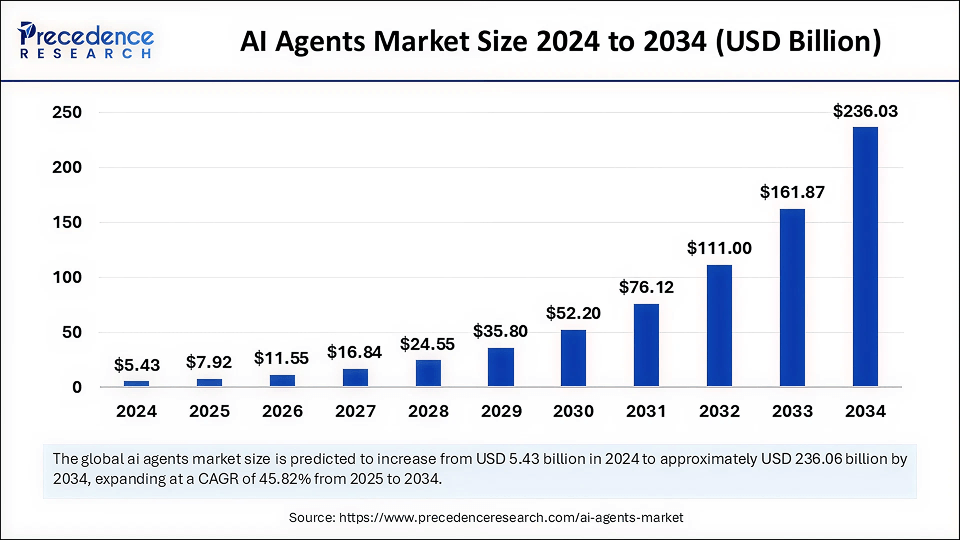
Source: https://www.precedenceresearch.com/ai-agents-market
The additional data that shapes the industry is the following:
The productivity and personal assistance segment leads the market by holding the largest CAGR of 29.5%.
By end use, the enterprises segment dominates the market with a 67% share.
The key use cases of AI agents in business are automation of financial reporting, IT support, HR onboarding and customer service operations.
The above-mentioned statistics mean that businesses are looking for new ways of using AI, and one of the key directions is the usage of advanced AI tools in internal operations optimization.
Customer service stands out in this field, as the primary objective lies in leveraging the AI capabilities for solving numerous customer support problems and reducing the workload from human specialists.
How is AI Used for Customer Service?
Considering the question of AI usage in customer service we come to the AI customer service agents. They are the new word in AI implementation for business operations, so it is vital to understand their essence and strong sides.
What is an AI Customer Service Agent?
AI customer service agent is a digital tool focused on performing customer service and support operations with the usage of artificial intelligence.
The range of tasks these tools can perform depends on the complexity of the agent itself. It varies from the primitive ‘question-answers’ operations to sophisticated multi-channel monitoring and user interaction.
AI support agents are typically integrated into larger corporate systems, like CRMs (Customer Relationship Management) or RMSs (Retail Management Systems).
How do AI Customer Service Agents Work?
The main difference between AI support agents and standard customer support chatbots is that the agents do not work according to the predefined scripts.
Traditionally, AI chatbots are fine-tuned to provide standard template answers to particular questions or present message lines as a response to certain events. They can’t go beyond these scripts.
On the contrary, AI agents are far more advanced tools, and their capabilities are based on a certain range of technologies.
- Natural Language Processing (NLP). The NLP technology is responsible for the AI agent’s ability to comprehend human language. When the AI receives the customer's message, it breaks down the sentence, identifies the intent and key message entities. It happens thanks to semantic text analysis feature, when the NLP-based tool can identify certain patterns between text parts. This is crucial, because customers can phrase the same request in countless ways, and the machine should comprehend them all connecting them with a single topic.
- Machine Learning (ML). The technology that defines the agent’s ability to learn from data and improve its own performance without being explicitly reprogrammed. Some tech support agents can analyze their own responses and whole conversations, identify certain patterns and see their response’s efficiency. Through that, they, in time, learn the most effective conversation lines and the most accurate solutions.
- Large Language Models (LLMs) API integration. This is more about the way you can leverage both NLP and ML in your tool. One of the options is to implement the customer support agent with an API of any popular advanced LLM (for example, ChatGPT). These models promote advanced capabilities of human-like text generation and are fine-tuned to constantly learn from previous conversations and external resources, so you’ll enable the highest level of efficiency and genuineness.
The following table provides additional information on how Ai agents differ from standard chatbots:
| Comparison Feature | Traditional Chatbots | AI Agents |
|---|---|---|
| Core technology | Pre-defined rules and decision trees. | NLP, ML, LLM API |
| Conversational abilities | Scripted. Guides users down a specific path. | Dynamic and contextual. Maintains context throughout a conversation, allowing for natural dialogue. |
| Functional flexibility | Inflexible. Cannot handle questions or commands outside the programmed rules. | Highly flexible. Can understand varied phrasings, learn from interactions and handle unexpected queries. |
| Development and implementation costs | Lower initial cost and complexity. | Higher costs because of the large data amounts, training and sophisticated infrastructure building. |
Want to receive a customer service solution that will surpass conservative chatbots? Let’s cooperate!
Are AI Customer Service Agents Useful?
Of course, and the understanding of this usefulness requires looking at their crucial benefits and a few examples of their successful implementation.
Benefits of AI in Customer Service

24/7 availability
One of the key benefits that companies seek in AI agents is that they can work around the clock.
You can set your AI agent for permanent customers' requests monitoring and solving. First, it enhances your business’s reputation and credibility, as users can get help anywhere and at any time. Second, you also decrease the workload from your support specialists as they can intervene only when the agent is unable to solve the problem or after the initial stage of the customer’s request.
Increased performance and omnichannel support
Another benefit lies in AI agents’ ability to process large numbers of requests from various channels simultaneously.
For example, you have customer channels on your website, corporate or department email and 2-3 social media. Standard practice would involve the work of 3-5 customer support specialists, or, in other case, one or two employees would be overwhelmed.
AI agent allows to easily overcome this challenge. A single tool can be set up for monitoring and processing requests from all these channels with no negative effects on the speed and quality of support operations.
At the same time, specialists can focus on their other duties. It is especially crucial in cases when the customer request implies interference by technical or manager-level specialists with a different responsibilities circles.
Reduced operational costs
Such implicit multitasking is one of the key traits that allow to sufficiently reduce customer support operational spendings, and this is what most of the businesses look for in AI implementation.
According to McKinsey research, more than half of the international executives indicate they want their companies to be among the first adopters of AI in any aspect of their business. This desire can be explained by the revenue they expect from their AI deployments. Some 31% of international C-suite leaders say they expect AI to deliver a revenue uplift of more than 10 percent by 2028.
This can be achieved not only through activities expansion but through cost reductions, and AI agents in customer support is one of the methods. There’s no need to hire a few junior support specialists to solve everyday low-level tasks (for example, answering repetitive questions).
An AI agent can solve them with an almost unchanged accuracy and speed, 24/7 and without obligatory payments (except for subscription or maintenance ones).
What are AI Customer Service Agents' Most Prominent Use Cases?
There are already thousands of companies all around the world who implemented AI agents in their customer service, but we’ll present only a few examples.
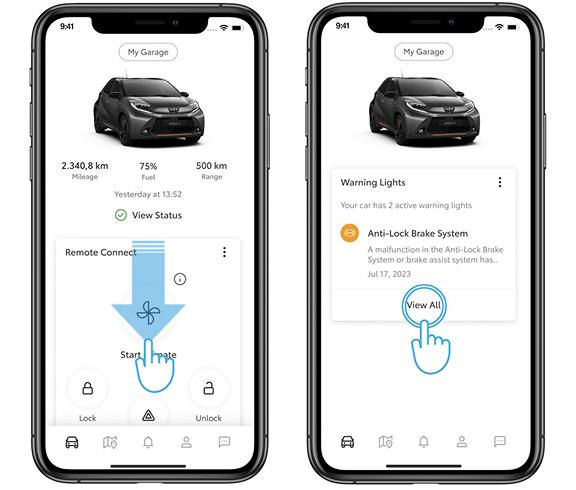
- Toyota’s ‘E-Care’ AI agent. Toyota wished to help their customers extend the life of their cars and reduce the workload of internal customer service teams, so they came up with ‘E-Care’. It is an AI agent that is directly connected to a car’s onboard electronics. The agent proactively contacts customers to alert them about repair or service requirements. Through that, the company's customer service teams are relieved from a large percentage of service calls. Furthermore, the AI agent has helped customers feel more valued and reduced the burden associated with manual service bookings.
- AI Agent for Bosch. Recognizing the potential of AI agents to streamline day-to-day tasks and improve the efficiency of their employees, Bosch created a Chatbot Suite. The agent supports over 90 different use cases within the organization. One of the most outstanding of them is Bosch Power Tool for contact centers that allows to listen in on calls, analyze sentiments, suggest the next best action to human specialists and provide an automated wrap-up.
- Lippert. A global manufacturer that supplies critical components for RV, marine and automotive brands required a united system for corporate data storage, customer support and employees onboarding. By the end of 2025, the company expects to save 2.1 million USD, reclaim more than 105 thousand hours and generate capacity equivalent to 51 full-time employees.
What are the Best Practices for Using AI Support Agents?
Though implementation peculiarities depend on every company’s needs, there are a few universal practices that should be followed to ensure maximum efficiency.

Being the part of customer service system
There are remarkable words said at the beginning of 2025 by Oana Cheta, a partner in McKinsey’s Chicago office who leads generative AI and agentic AI in service operations in North America.
'It’s not about automating tasks anymore. It’s about redesigning how work is done. This is not an efficiency play but rather a transformation play. So, deploying AI alone or generative AI alone is not enough. Companies must redesign their processes to integrate AI at the core of their operations.'
The key trait is that an AI agent must be a seamless component of internal management and support ecosystem. It should be integrated with the company’s CRM, RMS, knowledge base and ticketing system to access and provide accurate information, give status updates for the dedicated teams and automatically escalate complex issues to human agents. This ensures a unified customer journey where the AI handles routine queries, freeing up employees for high-value interactions, creating an efficient hybrid support model.

Permanent supervision
Despite being one of the most advanced AI tools, agents require continuous human oversight, especially in the tasks requiring interaction with humans. Both technical and support teams must regularly monitor conversations, analyze performance metrics and use customer feedback to identify errors or knowledge gaps.
In other words, any AI system needs ongoing training and refinement based on real-world use to ensure its responses remain accurate, helpful and aligned with brand voice and policies.

Helpers, not employees
Now it is vital to position AI as a helpful assistant, but not a full replacement for human empathy and judgment. You should clearly understand its limitations. Its core function is to provide instant answers to common questions, gather information and assist human specialists. However, they are not as good at handling sensitive complaints or complex emotional issues.
However, non-functional testing sub-types, like performance or usability testing play a crucial role in final product’s quality. System’s performance and convenience are crucial for positive user experience, and their neglection leads to decreased interest in product.
'When you don’t delegate 100% of your work to AI, you build trust and set correct customer expectations. You ensure that the AI is implemented without frustrating users. This is the key idea, the red line that goes through the current state of AI development and its implementation approach.'
Final Words
The integration of AI customer service agents is a fundamental shift in businesses’ approach to customer support. Now it is more than primitive rule-based chatbots. By leveraging advanced AI technologies, these systems provide 24/7 availability, omnichannel support and significant operational efficiency.
However, their true power emerges when they are properly implemented – as integrated components of the entire customer service ecosystem. It means that the key to success lies not only in proper settings, but in permanent human oversight, realistic expectations and in positioning AI as an enhancement rather than a replacement.
What all companies should remember these days, when AI looks so attractive and promising is that it’s not about choosing between human and artificial intelligence. Real strategic planning lies in mastering how they can collaborate to deliver exceptional customer experiences.
And if you are unable to perform it on your own, apply to professionals, like Silk Data, who have dedicated many years to finding the most efficient ways of implementing AI into business operations.
Reach our C-level specialists and feel free to discuss your needs!
Frequently Asked Questions
Basic chatbots are developed to follow pre-written scripts, and they hardly can provide conversational lines that go beyond these scripts. At the same time, AI agents use advanced technologies of Natural Language Processing and Machine Learning. Through that, they can not only perceive human text, but also understand the intent behind a customer's question, learn from interactions and generate dynamic, human-like responses.
No, and it shouldn't. The most effective strategy is to use AI as a helper. It excels at handling routine, repetitive queries around the clock, relieving your human agents and allowing them to resolve complex issues (for example, handling sensitive complaints) or provide the empathy and strategic thinking that AI still lacks.
Advanced AI agents are typically integrated with the company's knowledge base, CRM and other systems. This allows them to retrieve accurate, up-to-date information. Furthermore, continuous human supervision and training on past interactions (based on ML technology) help the machine to refine its accuracy and align its responses with company’s policy.










Our Solutions
We work in various directions, providing a vast range of IT and AI services. Moreover, working on any task, we’re able to provide you with products of different complexity and elaboration, including proof of concept, minimum viable product, or full product development.