By the Silk Data engineering team. Based on 10+ years of production IDP deployments across publishing, FinTech, marketing, and EdTech, including on-prem LLMs, large-scale document search, and academic content pipelines.
PDFs, emails, contracts, scans, support tickets, images. Most of what a business actually knows lives in formats no SQL query can touch. Intelligent Document Processing (IDP), sometimes called document AI, is the pipeline that turns that mess into structured fields a dashboard, a RAG agent, or an approval workflow can use. This article walks through the four stages of unstructured data processing that matter - parsing, extraction, governance, retrieval - with the trade-offs we have seen on real projects.
Key Takeaways
- IDP has four stages that each fail differently: parsing, extraction, governance, retrieval. Most projects fail at governance, not at the model.
- AI parsing wins on degraded and variable layouts. Rule-based RPA still wins on cheap, high-volume, fixed templates. Pick by document variance, not hype.
- Schema generation is a living process. Document types drift. Build a human-in-the-loop review cycle from day one.
- If personal data is involved, GDPR applies. If the system is high-risk under the EU AI Act, the act applies on top. They are separate regimes, not a single checklist.
- For regulated industries, on-prem LLM deployment removes a whole class of compliance risk. Cost and latency change too, in both directions.
- Budget reality from our pilots: data preparation eats 50-65% of effort. Modeling is 10-15%. Plan accordingly.
- For deeper technical background on the modern RAG and orchestration stack, see our AI development tech stack guide.
How AI Parses Unstructured Content
Parsing turns a file into text and layout a model can reason over. Quality here caps everything downstream. A bad parser cannot be rescued by a better embedding model.
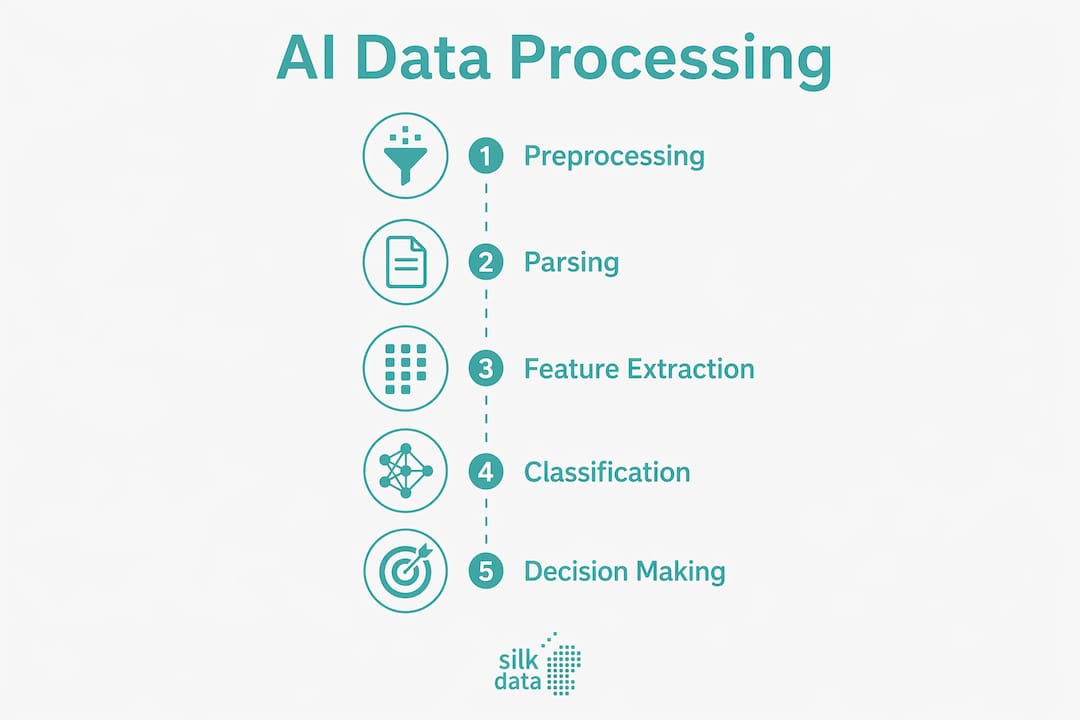
The work is unglamorous: deduplicate files, fix encodings, normalize PDFs, DOCX, scans, and HTML into a shared representation, detect tables, strip boilerplate, then chunk along sentence or paragraph boundaries. Modern parsers combine OCR with layout models so a date in a contract header is treated differently from a date in a footer.
The honest comparison with rule-based RPA looks like this.
| Dimension | AI parsing | Rule-based RPA |
|---|---|---|
| Fixed templates, clean scans | Works, often overkill | Cheap, fast, accurate |
| Variable layouts, mixed quality | Holds up via semantic cues | Breaks on layout change |
| Setup time | Days to weeks | Days, then ongoing fixes |
| Maintenance | Targeted review of edge cases | Continuous template patching |
| Cost per document at scale | Higher (compute, embeddings) | Lower if templates hold |
The trade-off is real. If 95% of your incoming documents are identical purchase orders from three suppliers, rule-based extraction is cheaper and easier to audit. If you ingest 200 contract templates from 40 counterparties, AI parsing earns its cost back in the first quarter.
Two practical notes from our own work. First, on a large-scale image search system covering more than 6 million images, we found that consistent preprocessing - cropping, denoising, normalization - mattered more than swapping the underlying model. Second, chunking strategy is where most RAG projects bleed quality. Split at sentence or paragraph boundaries, not at fixed character counts.
How AI Extracts Fields and Generates Schemas
After parsing, the pipeline turns raw text into labeled fields. This is AI document extraction, classification, and schema generation - the part that produces something a database can hold.
The workflow we use on production projects:
- Embed every document into a vector representation for vector search and clustering.
- Cluster the embeddings. Natural document types emerge from the data, not from a guessed taxonomy.
- For each cluster, draft a JSON schema with field names, types, and required flags.
- Flag overlapping or ambiguous clusters. A reviewer decides whether to split or merge them.
- Lock the schema for production. Keep a change log.
For deeper coverage of upstream data discipline that makes downstream schemas work, see our guide on data strategy for AI.
The trap is treating this as a one-time setup. Document formats drift. A new supplier adds a field. A regulator changes the form. Six to eighteen months later, depending on how fast document sources change, extraction quality silently degrades. Schema review needs a cadence - quarterly is a reasonable starting point, monthly if volumes are high.
A concrete example from our portfolio: in our AI resume screening work for FinTech and marketing clients, the same role at two companies asks for different evidence. Hard-coded field lists missed half the signal. Cluster-driven schemas, refreshed each quarter, caught it.
Pros of LLM-driven schema generation: it scales across hundreds of document types, surfaces categories you would have missed, and reduces upfront analyst work. Cons: it hallucinates fields when clusters are too small, requires human review to be safe, and adds embedding and LLM inference cost per document. Worth it above roughly a few thousand documents per type. Below that, write the schema by hand.
Why Do Most IDP Projects Fail at Governance?
Most IDP failures we are called in to fix are not model failures. They are governance failures. The model performed as designed, but the document corpus it consumed was outdated, duplicated, or unowned.
Three governance practices make the difference between an IDP system that is trusted and one that quietly poisons decisions:
- Ownership: every document class has a named owner on the business side. No owner, no production access.
- Lifecycle: documents have an explicit expiry or review date. Policies older than the rule they reference are archived, not retrieved.
- Permission-aware retrieval: the search layer respects access control at query time, not just at ingestion. A user without access to a contract should never see a chunk of it surface in a chatbot answer.
- Audit trail: every extraction decision is reproducible. Which document version, which extraction model version, which schema version. Without this, a compliance query about a decision made twelve months ago has no defensible answer.
The legal layer sits next to this, not inside it. Keep the lines clean.
- If you process personal data of people in the EU, GDPR applies. It governs lawful basis, retention, and subject rights, regardless of whether AI is involved.
- If the system itself is classified as high-risk under the EU AI Act, more obligations apply on top: risk management, data governance, logging, human oversight.
- In May 2026, the Digital Omnibus on AI agreement deferred Annex III high-risk obligations to December 2027. That widens the compliance window for high-risk workloads but does not change the design principles. Systems built today with governance, logging, and human oversight in mind avoid rework when the deadline arrives.
- UK deployments answer to the ICO under UK data protection law.
- US teams without a binding federal AI law often align voluntarily with the NIST AI Risk Management Framework.
- Education products handling US student records also fall under FERPA.
For the full compliance picture across FERPA, GDPR, EU AI Act, and US state laws, see our guide to data privacy in AI deployment.
These are separate regimes with different triggers. Lumping them into one bullet point is how teams miss obligations.
Polina Volodina, AI Advisor at Silk Data, frames the scoping question we ask clients before any architecture is drawn: "Before we discuss models, we map which data is personal, which jurisdiction it sits in, and who owns each document class. That decides whether the system can run in a public cloud at all."
For clients in regulated sectors, the answer is often on-prem. We have deployed local LLMs inside a marketing agency's internal platform so client data never leaves the perimeter. The trade-off is real: on-prem means more setup, fewer model choices, and infrastructure cost. It also removes a class of compliance and confidentiality risk that no API contract can fully neutralize.
How Pipelines Turn Documents Into Decisions
The output of an IDP pipeline is not clean data. It is faster, defensible decisions. A contract review that took two days now takes two hours. A claim that needed three handoffs now routes itself.
For RAG pipelines specifically, retrieval quality - not generation quality - decides whether the answer is right. Two patterns are worth enforcing from day one:
- Multi-level indexing. Store fine-grained chunks for precision and parent-level metadata (title, section, page, document type) for context. A chunk without its parent is often technically relevant and practically wrong.
- Separate ingestion and retrieval pipelines. Batch-optimize embedding and chunking on ingestion. Keep query-time retrieval lean and consistent with the same embedding space. Coupling the two is how teams discover, post-launch, that a document update re-embeds the entire corpus.
- Hybrid retrieval. Combine dense (vector) and sparse (keyword) retrieval. Dense retrieval handles semantic queries well but misses exact-match cases (contract numbers, invoice IDs, statute references). Hybrid retrieval catches both.
- Query rewriting. User questions rarely match how documents are written. A query rewriter (LLM-based) reformulates the question into forms that match retrievable content. Adds latency, saves recall.
Two production examples from our work show the shape of useful output. In our automatic news analysis project, parsed articles feed clustering, opinion mining, and cross-source comparison delivered as a Chrome extension. Editors get differences between sources, not a wall of duplicates. In a 7-year partnership with a German publishing house, we built AI search and a local LLM over their archives.
How Silk Data Builds IDP Systems That Hold Up
We have shipped NLP and document processing systems for publishing, FinTech, marketing, and EdTech clients. The pattern that repeats: start with a 3-month proof of concept on a real document subset, measure against a baseline (often the existing manual process or rule-based RPA), and only then commit to full rollout. If SQL or a rules engine is enough, we say so. If on-prem is the only defensible deployment, we say that too. For a deeper look at when custom AI development pays off versus off-the-shelf platforms, see our guide on custom AI development.
Yuri Svirid, CEO of Silk Data, on the call we make most often with new clients: "The first deliverable is usually not a model. It is a clear answer on whether to build, buy, or skip. About a third of the time, the honest recommendation is that this problem does not need AI yet. That conversation is worth more than a pilot that should never have started."
For a buyer-facing view of the same problem space, our guide to AI document processing examples walks through use cases, tooling layers, and platform categories.
If you have a document corpus you cannot query, write to hello@silkdata.ai with the document types, volumes, and jurisdiction. We will tell you what a useful first 3 months looks like.