
Expert’s Thoughts

"As we considered various JavaScript frameworks in one of the previous articles, now it’s time to answer the question of ‘what is JavaScript?’.
Silk Data team have prepared the following blogpost to provide a comprehensive overview on one of the most popular programming languages. We’ll follow its history, see its foundation, find out why we can’t find an alternative 30 years later."
Yuri Svirid, PhD. — CEO Silk Data

Before we get into considering various aspects of JS, let’s have a look at some insights. Resources like BuiltWith, DEVS 2025 and W3Techs provide us with the following data.
- From September 2024 to September 2025 JavaScript has held an average grade of 98.9% in the usage of client-side programming languages for websites (W3Techs).
- Special sampling demonstrates that around 83% of professional developers code in JS on a daily basis (DEVS 2025).
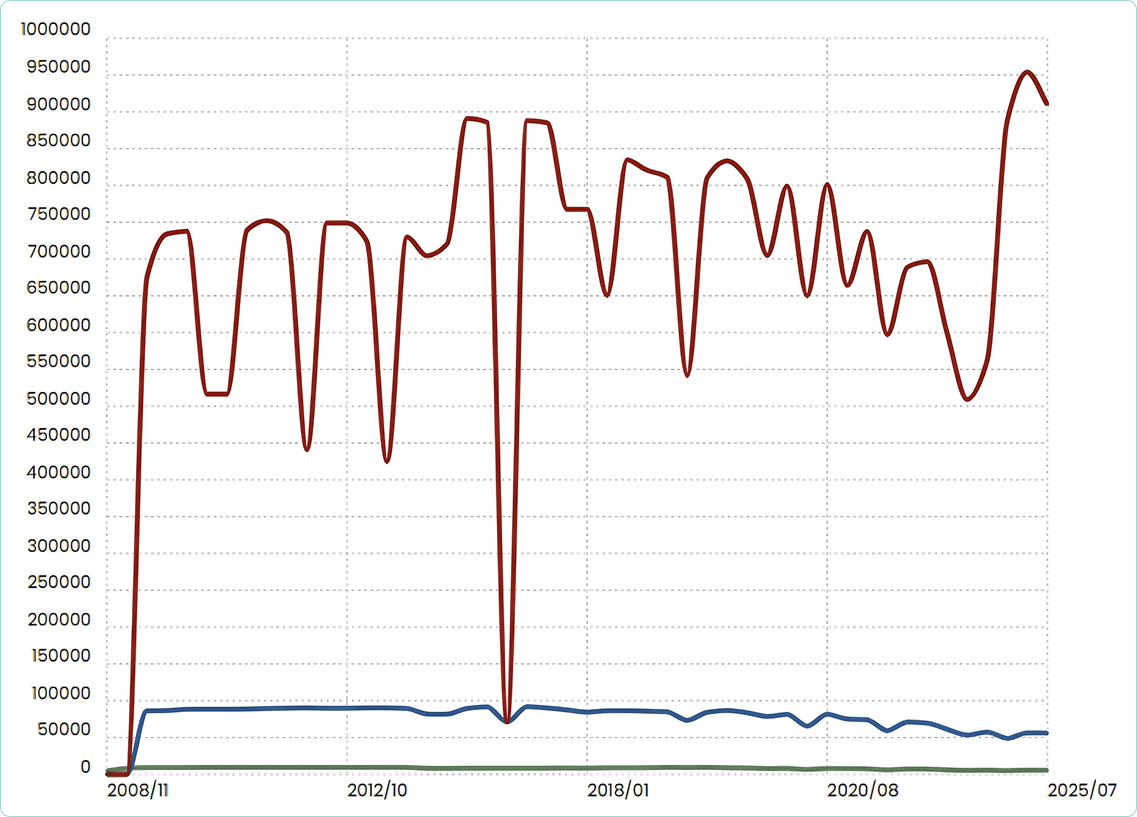
- More than 900 thousand websites registered on the Internet by August 2025 have been created with JS (BuiltWith).
- The global annual salary median for JS developers was 70 000$ in the mid-2025 (DEVS 2025).
The History of JavaScript Programming Language
30 years of JS history can be efficiently divided into five periods, and each period demonstrates that the road to popularity wasn’t easy.
- 1
1995 – 1999. Browser Wars
Creation and release
In 1995 the developers from a US-based computer service corporation and an owner of web browsers series named Netscape Navigator shared their initiative on creating a new tool to build dynamic web interfaces. It should have been ‘a language for the masses, to help non-programmers create dynamic and interactive websites’.
For that purpose, the company hired Brendan Eich, an experienced programmer, who created the language in just ten days, and, after a few versions, it was named JavaScript. The language had no connection to Java, and the name was only a marketing move to get the community’s and industry’s attention.
The start of browser wars
However, in 1995 Microsoft released its Internet Explorer, and the year after the company presented its own interpreter (i.e. software aimed at executing encoded logic) named JScript. From this point the ‘browser war’ between Netscape and Microsoft started, and they brought nothing more but confusion among web developers.
As JScript was followed by new CSS and HTML extensions and support, the result was noticeably different from their counterparts in Netscape Navigator.
As a result, developers struggled to make their websites work well in both browsers, and this led to the appearance and widespread use of ‘best viewed in Netscape’ and ‘best viewed in Internet Explorer’ logos around the web, and the situation lasted for several years.
- 2
2000 – 2004. Standardization Era
The situation caused lots of inconveniences for web developers, who could ensure the JS code would work on a particular browser, for companies who had to choose between Navigator and Internet Explorer for their websites promotion and for users who had to use particular web browser to see certain content. The situation couldn’t last for long, so the standardization era came.
In 1999 Ecma International, a non-profit organization published a standardized specification of the JS language named ECMAScript. It served as a universal rulebook that all browsers, including those of Netscape (succeeded by Mozilla since 2004) and Microsoft could follow.
The ECMAScript release became a revolution that broke the web stagnation caused by browser wars and Internet Explorer’s web dominance. It ensured that any piece of JS code would act similarly whether it’s used within Netscape Navigator, Internet Explorer or any other existing or future browser.
The features formulized by ES became fundamental for JavaScript, including:
- Regular expressions. Features for powerful text search and manipulation.
- Better string handling. New methods to make working with text easier were formulated.
- Try/catch exception handling. A new proper way to handle errors, making applications more robust.
- Formatting for numeric output and many more.
Even though browser competition continued for more than a decade further, ES became JavaScript for developers and built ground for continuous development.
- 3
2005 – 2008. Ajax Revolution
Nonetheless, Ecma were not the only ones who contributed to the JS evolution. In 2005 a UX designer Jesse James Carrett, with the help of an open-source community, released a white paper where the term Ajax (Asynchronous JavaScript and XML) was introduced.It was a set of technologies for web applications creation where data can be loaded in the background, avoiding the need for full page reloads. As the backbone of the technology was JavaScript, it was a spark that lightened the new stage of the language’s evolution.
Apart from the ever-growing standardization, new JS libraries were released (jQuery, Prototype, Dojo Toolkit, etc.), and most of them have been used to this day.
- 4
2009 – 2014. Renaissance and Industry Conquering
Google Chrome release
In 2008 Google debuted its Chrome with the V8 JavaScript engine allowing the browser to operate faster than any of its competitors. The key to such speed was in JIT (just-in-time) technology implementation that allowed to compile the code not before the program execution but simultaneously to it.
Such a great Google’s head start made other web browser owners to quickly overhaul their browser engines for JIT.
The end of browser wars and JS rapid development
In July 2008 all disparate web browser vendors came together for a conference in Oslo. The conference led to the common agreement in early 2009 to combine all relevant work and drive the language forward. After that multiple new JS-based products were released.
- Node.js release. An open-source JavaScript environment created in 2009. It allowed JavaScript to run on the server, breaking it out of the browser and revolutionizing full-stack development.
- ECMAScript 5 release. The initial result of the Oslo browser vendors conference, released in December 2009. It added strict mode, JSON support and array methods (like ‘map’, ‘filter’ and ‘reduce’), making the language more serious and functional.
- Frameworks appearance. The 2010s were the time when the most popular JavaScript frameworks were released, including Angular (2010), React (2013) and Vue (2014). All three introduced component-based architectures for building complex and large-scale single page applications.
Note! JavaScript frameworks are efficient tools for building web applications of different scales, but the right option may still be unobvious. Through that, we thoroughly discovered all the strong and weak sides of Angular, React and Vue in one of our previous blogposts.
So, by the mid 2010s JavaScript had become a full-stack, ubiquitous language, already considered as the most popular technology for web development purposes.
- 5
2015 – Present. The Backbone of the Modern Web
The last decade was characterized by rather stable development of the JavaScript programming language with a few significant innovations.
- The release of ECMAScript 6. In 2015 the Ecma company added major new syntax and features to the language. These are new arrow functions, promises, classes, modules, template literals and many more.
- Increased number of assistance tools. Tools like Webpack, Rollup, and Vite were created to assist coders with problems that can’t be performed with plain JS. Now convenient code transformation and splitting along with a separate development server provision became available.
- The rise of TypeScript. A typed superset of JavaScript developed by Microsoft that quickly gained massive adoption and got leveraged for large-scale applications.
- Full-stack frameworks appearance. Late 2010s were the time when several new frameworks appeared (Next.js, Nuxt, Svelte, etc.). Their adoption allowed to focus on the tasks of SEO, optimized web performance and easier deployment.
Though JavaScript was probably not the best or easiest of the programming languages (and it still isn’t), but it was one of the first. At the same time, an ongoing improvement and ever-growing tooling and community have made it the most popular language for building websites and web applications.
The Key Features of JavaScript
Let’s dive deeper into the JS nature and find out the features and JavaScript code specifics that make JavaScript practically indispensable in web development.

Imperative and Structured Programming Language
In essence, JavaScript's basic control flow, i.e. the logic that decides which code runs, is borrowed from the C programming language. It implies that if the programmer knows the principle of statements and loops in C, they will understand the same principles in JS.
There are also some more traits caused by the imperative and structured nature of JS, both similar and different to those of C:
- A distinction between expressions and statements. While a statement is an instruction that performs an action and doesn't produce a value on its own, an expression is a piece of code that produces a value. In JS they are strictly differentiated, while some languages (like Ruby) may provide confusion.
- Block scoping. In 2015 JS shifted to this technology, abandoning function scoping. It means that now in JS code all variables within a code section (blocks) were accessible only within this particular section. Such a system prevents variables from accidentally ‘leaking’ out of their intended context, which lowers the number of bugs.
- Automatic semicolon insertion. In C, every statement must end with a semicolon ‘;’, and the compiler will throw an error, if you forget one. JS has an automatic insertion feature, so the system will put it at the end of lines if you omit them.
Weakly Typed Programming Language
The core idea of this trait is that JavaScript (as well as any other weakly typed programming language) tries to be helpful and ‘guess’ developer’s coding intention, rather than enforcing strict type rules.
For example, the ‘+’ operator is used for both addition (with numbers) and concatenation (with strings). JavaScript is allowed to decide what to do based on the code context.
Although it may sound convenient, in reality weakly typed languages cause serious debate among the developers who see such an approach as one of the sources for JavaScript code bugs.
The fact that JS is a weakly typed programming language was one of the main reasons why TypeScript with its strict typing system has become so popular for the past years, getting a higher level of developers' admiration (58% against 47% respectively).
Dynamic Programming Language
Apart from being imperative and weakly typed, JavaScript is also dynamic, and this term implies two key principles.
Dynamic typing
In JS variable types are not fixed. It means that a single variable can hold a value of any type (a number, a string, an object, etc.), and its type can change at any moment during the execution of the program.
On the one hand, this offers great flexibility but puts the burden of type checking from the computer on the developer. On the other hand, in such an approach errors related to incorrect types (for example, when the system is trying to call a method that doesn't exist on the current type) will only be discovered when that line of code is executed.
On the contrary, statically typed language like Java or C#, declare a variable's type and it can only ever hold values of that type. Unlike in JS, the type is checked before the code runs.
Run-time evaluation
This concept implies that the structure of JS code can be modified while the program is running. The developer can define new functions, change an object's properties or even generate and execute entirely new code.
Once again, the concept makes JavaScript extremely flexible, especially for tasks like metaprogramming, when we create a code that should manipulate other code.
However, the code itself and the program in total become harder to optimize, text and modify by any third-party tools. The reason is that the full program structure isn't known until it's actual running.
Object-Oriented Programming Language
Object-oriented programming is the programming paradigm that puts objects (collections of data and behaviors) in software’s code design above functions, business logic and other entities. JavaScript supports the object-oriented programming approach and has a few features that both unite it with other OOP languages and differ it from them.
Prototypes
Prototypes are the thing that differentiates JS from other object-oriented languages. Java and C++, being OOP languages as well, rely on the principle where objects are created from classes (static templates that define objects’ state and behavior).
In JavaScript, however, every object is linked to another object, which performs as its prototype. When the developer tries to access a property or method on an object, JavaScript first looks for it on the object itself. If it doesn't find it, it looks up to the object's prototype, then the prototype's prototype, and further on chain, until it finds it or reaches the end of the chain.
Why is it necessary? Once again, this approach provides more flexibility and convenience, as objects can inherit properties and methods from other objects.
Functions and object constructions
In JavaScript any function can be turned into a constructor function and then act as a blueprint for creating objects.
When the constructor function is created, inside it, the ‘this’ keyword refers to the new object being created. Properties (states) and methods (behaviors) assigned to this become the properties of the new object.
In essence, constructor functions usage is just another way to create multiple objects of the same ‘type’, similar to the classes system.
Functions and methods
The concept that refers to JavaScript simplicity.
There is no special ‘method’ definition in JavaScript. Any method is nothing more than a function that has been assigned as a property to an object.
While in some languages methods are defined explicitly within a class structure, JavaScript has a blurry line between functions and methods, and everything fully depends on how it's called.
Browser Security Issues
One more thing to be considered is the security problems that JS-based products come across. There are two most faced security issues, regarding JavaScript.
Cross-site scripting
It is the practice when an attacker injects malicious JavaScript code into a vulnerable website, which is then executed in the user's browser. Through that, the attackers can steal session cookies, log keystrokes, deface websites, get access to the information and operations without user’s authorization or redirect users to malicious sites.
The primary defense against cross-site scripting is a combination of input sanitizing with further output encryption. All user input must be treated as untrusted, and, before displaying it on a page, it must be properly encoded to prevent it from being interpreted as executable code.
Cross-site forgery
The meaning of this method is the following. An attacker tricks a logged-in user's browser into making an unauthorized request to a website where the user is authenticated. The browser automatically sends cookies with every request to a site. An attacker can embed a hidden request (in an image tag, form or script) on a malicious site that exploits this trust.
A possible solution for the issue is to require an authentication token in the ‘POST’ and ‘GET’ parameters for any response that returns private information.
Why do We Still Need JS in 2025 and Further?
We saw that JavaScript is a language with a long history, large ecosystem and a number of features that still make it attractive for many developers. But is JavaScript’s meaning really that crucial for the web development industry? Can we finally find and use a worthy alternative?
The answer is negative, and we can highlight several reasons for that.

A Historical Foundation
As JS was one of the first programming languages used in web development and the first aimed at building dynamic web applications and websites, it is the only programming language that runs natively in web browsers. It has become an integral part of the web platform, alongside HTML and CSS.
Consequently, all web APIs (like the DOM, Fetch, Canvas, etc.) are designed to be used by JavaScript as well.

Enormous Ecosystem
- Npm. It is a specialized package manager for JS maintained by the subsidiary of GitHub. Npm is the largest software registry in the world, containing more than 2.5 million packages and solutions (from utility functions to entire frameworks).
- Talent pool. By mid 2025 there were around 28 million active JavaScript developers worldwide, the fact that can’t be neglected by any business who wants to be present online. For a business, choosing a technology means choosing from the available talent pool, and JS offers the largest and most diverse range.
- Community knowledge. The collective knowledge around debugging, best practices, tutorials and solutions for JavaScript is immense. Any new (or even not so new) language lacks this decades-deep knowledge base.
To the above-mentioned points we can add a large technological ecosystem, as there is hardly possible to find a programming language having an equal number of frameworks, libraries or ‘subsidiary’ languages.
Finally, various linters, formatters and bundlers ensure safety and developer experience that mitigates JavaScript's rough edges.

‘Written Once, Run Anywhere’
It was the initial promise of the JS creators which has become truth by 2025, and we talk not only about building for browsers.
Using Node.js, developers can use the same language on both the frontend and backend parts. At the same time, frameworks like React Native, Capacitor and NativeScript allow companies to use their JavaScript talents to build native mobile apps, desktop apps and even embedded systems.
Altogether, these factors make JS a truly universal language that gained not only web but also full-stack and cross-platform development dominance.

Bonus. Risks of Changing
Finally, no large business will bet its entire web product on a new, unproven language that might be abandoned in two years. JavaScript is backed by all major tech giants, and its 30-year history has made it the safest and least-risky option.
In addition, you’d hardly find a business who’d be ready to spend extra time and money and lower its operations capacity for switching to another programming language and rewriting its web products.
Why Should You Choose Silk Data as Your JavaScript Developer?
Our company is a trusted partner with 10+ years of experience in JavaScript development, and many successful JS-oriented projects. Here are the reasons why we can help you:

Full development cycle
For many years of providing custom development services, we have mastered our working practices. No matter the project specifics, our team is capable of taking full responsibility from the first to the last stage. Requirements and analytics gathering, UX/UI planning and prototyping, functionality development, quality assurance and deployment – you can delegate everything to our specialists and supervise progress at any stage.

Monitoring and maintenance
We tend to cooperate with our clients and partners even when the project is formally finished. You can ask for additional monitoring and maintenance work, and dedicated specialists will be supervising your product, tracking functionality and UI bugs and performance downfalls, quickly repairing them.

JS outstaffing
If you don’t want to fully delegate the JS project to third parties, but still require professional JS developers, Silk Data can offer their specialists. We have come up with an efficient outstaffing system and ensure that specialists integration will go as smoothly and efficiently as possible.
Conclusions
Thirty years after its creation JavaScript has evolved from a simple scripting tool into the unchallenged sovereign of modern web development.
As we've seen, JavaScript's dominance isn't just a historical accident, but a result of its powerful ecosystem, universal browser support and the unparalleled flexibility combination. Now JavaScript is a language that allows you to build everything from simple websites to complex server-side applications and mobile apps. While other languages (WebAssembly, Dart, Python) are able to replace JS in some cases with the usage of Transcript and other tools, they still can’t challenge it on the level of native support and ecosystem scales.
As for TypeScript, it is truly the language that follows JavaScript in its development, but it still can’t replace the JavaScript foundation.
In essence, for businesses and developers alike, JavaScript continues to be the most pragmatic, powerful and yet future-proof choice for building for the web and beyond.
Frequently Asked Questions
JavaScript is both. It is the core scripting language for frontend development, running in web browsers to create interactive websites. With the creation of Node.js, it also runs on servers, making it a full-stack language for backend development, APIs, and building server-side applications.
Java is a compiled, statically typed language often used for large-scale enterprise backend systems, Android apps and desktop software. JavaScript is an interpreted, dynamically typed language designed for the web, running in browsers and on servers. The similar name was nothing more but a marketing tactic.
JavaScript is primarily used to create dynamic and interactive behavior on websites. This includes features like animations, form validation and responsive user interfaces. With Node.js release, it started being used for backend development (like servers, APIs), while React Native made it possible to build mobile apps with JS.
Yes, but not exclusively. All modern websites use JavaScript for interactive frontend functionality (animations, dynamic content, forms). However, the core structure is built with HTML and styling with CSS. Furthermore, many websites use JavaScript on the backend (with Node.js) to power their servers and serve web pages.


















Our Solutions
We work in various directions, providing a vast range of IT and AI services. Moreover, working on any task, we’re able to provide you with products of different complexity and elaboration, including proof of concept, minimum viable product, or full product development.