
Most executives have seen dashboards. Many have deployed business intelligence tools. But confusing those reporting layers with true advanced data analytics is one of the most common and costly mistakes in modern enterprise strategy. Advanced analytics is not about prettier charts or faster queries. It is about predicting what will happen next, prescribing what to do about it, and automating those insights into operational workflows before a competitor acts first.
Defining Advanced Data Analytics: Moving Beyond Reporting
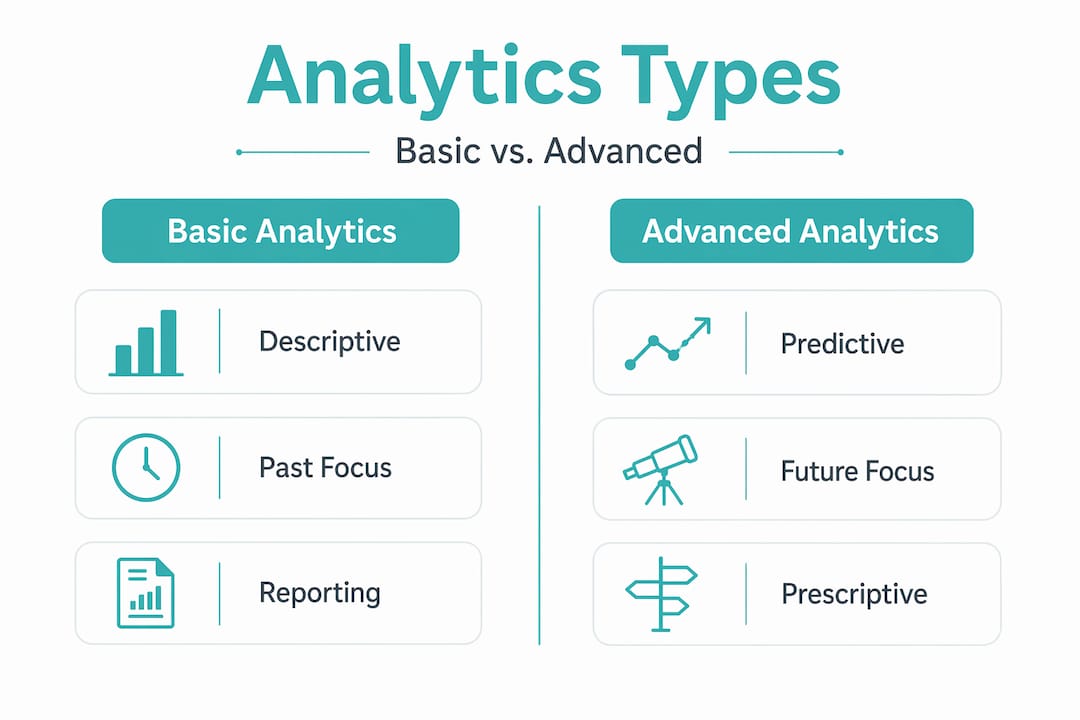
Standard business intelligence tells you what happened last quarter. Advanced data analytics tells you what will happen next quarter and what you should do about it. That distinction carries enormous strategic weight.
Advanced data analytics moves beyond descriptive reporting toward predictive and sometimes prescriptive analysis, shifting the entire orientation of data work from backward-looking summaries to forward-looking decisions. For executives managing complex operations across finance, healthcare, or education, that shift is not incremental. It is transformational.
Advanced analytics is an umbrella covering multiple methodologies used primarily for predictive purposes, including machine learning, predictive modeling, neural networks, and AI. The practical scope also extends to statistical modeling techniques such as regression, classification, and clustering, as well as experiment design methods like A/B testing.
What separates advanced analytics from basic reporting comes down to several core characteristics:
- Predictive orientation:Models forecast future outcomes rather than summarize past events.
- Unstructured data handling: Text, images, sensor feeds, and social data are incorporated alongside structured records.
- Automation: Insights are generated continuously, not just in scheduled reports.
- Prescriptive capability: Some systems recommend specific actions, not just predictions.
| Dimension | Basic analytics | Advanced analytics |
|---|---|---|
| Focus | What happened | What will happen and what to do |
| Data types | Structured only | Structured and unstructured |
| Techniques | Aggregation, filtering | ML, regression, neural networks |
| Output | Reports, dashboards | Predictions, recommendations |
| Update frequency | Scheduled | Continuous or near real-time |
Explore how data science & advanced analytics capabilities integrate across business functions, or review a practical example in the Pandas use cases case study.
Pro Tip: Do not equate “advanced” with AI alone. Strong data governance, clean pipelines, and rigorous experiment design are just as important as the algorithms powering your models.
Core Methodologies and Tools: From Descriptive to Prescriptive Analytics
With a clear definition established, the next step is understanding which methodologies power advanced analytics and how each one delivers business value.
Healthcare analytics commonly spans a set of analytics types including descriptive, diagnostic, predictive, prescriptive, and discovery. This taxonomy applies equally well across finance and education, providing a practical framework for any executive mapping out an analytics roadmap.
Machine learning and statistical modeling such as regression, classification, clustering, and hypothesis testing form the technical core of advanced analytics implementations. Each method addresses a different class of business question.
| Analytics type | Core question | Business application |
|---|---|---|
| Descriptive | What happened? | Revenue reporting, patient volume summaries |
| Diagnostic | Why did it happen? | Root cause analysis, churn attribution |
| Predictive | What will happen? | Demand forecasting, fraud likelihood scoring |
| Prescriptive | What should we do? | Resource allocation, treatment pathway optimization |
| Discovery | What patterns exist? | Customer segmentation, anomaly detection |
A typical implementation follows a structured sequence:
- Data collection and integration: Consolidate structured and unstructured sources into a governed data layer.
- Data preparation: Clean, normalize, and label datasets to reduce noise and bias.
- Model selection: Choose appropriate algorithms based on the business question and data characteristics.
- Training and validation: Train models on historical data and validate against holdout sets to measure accuracy.
- Deployment: Integrate models into operational workflows via APIs or embedded analytics platforms.
- Monitoring and iteration: Track model performance over time and retrain as data distributions shift.
In finance, predictive modeling identifies fraudulent transactions before they are processed, reducing losses and false positives simultaneously. In healthcare, risk stratification models flag patients likely to deteriorate, enabling proactive intervention. Geisinger Health System deployed AI-driven risk prediction that reduced avoidable ER visits by 10%, demonstrating measurable clinical and financial impact.
Review predictive analytics case studies to see how these methodologies translate into production-grade solutions. Organizations also use analytics-driven approaches to optimize lead scoring with analytics across sales pipelines, connecting data science directly to revenue outcomes.
Industry Use Cases: Advanced Analytics in Finance, Healthcare, and Education
Techniques only create value when applied to real business problems. Across finance, healthcare, and education, advanced analytics is already generating measurable competitive advantage.
Advanced capabilities often include integration of AI and ML to handle broader data sources and support forecasting, risk and fraud use cases, and action-oriented decisioning. This integration is what separates organizations that react to events from those that anticipate and shape them.
Finance:
- Credit risk models assess borrower default probability using hundreds of behavioral and transactional variables.
- Real-time fraud detection systems classify transactions within milliseconds, flagging anomalies before settlement.
- Portfolio optimization engines prescribe asset allocation adjustments based on market signal analysis.
Healthcare:
- Healthcare analytics spans quantitative and qualitative methods across data sources including EHRs, imaging, claims, and wearables, enabling a 360-degree view of patient risk.
- Predictive readmission models identify patients likely to return within 30 days, prompting targeted discharge planning.
- Resource allocation tools forecast staffing needs by shift, department, and seasonal demand patterns.
Education:
- Early warning systems flag students at risk of dropout based on attendance, grade trends, and engagement data.
- Personalized learning platforms adapt content delivery in real time based on individual performance signals.
- Enrollment forecasting models help institutions plan capacity, staffing, and financial aid allocation.
“Geisinger used AI to identify high-risk individuals, allocate resources, and drive timely interventions, achieving a 10% reduction in avoidable ED visits.”
See how these patterns play out in financial services through FinTech analytics cases, or explore how AI-driven marketing services extend analytics into customer acquisition workflows.
Pro Tip: For maximum ROI, prioritize cross-functional data integration before model development. A model trained on siloed data will consistently underperform one trained on a unified, governed data asset.
Critical Success Factors: Governance, Quality, and Operationalization
Understanding the techniques and use cases is necessary. But the difference between a successful analytics program and an expensive experiment almost always comes down to governance, data quality, and operationalization.
Predictive and advanced approaches still depend on sound data foundations and proper governance. Without those foundations, automation does not eliminate errors. It amplifies them at scale, faster than any human review process can catch.
Common pitfalls that derail analytics initiatives include:
- Poor data hygiene: Duplicate records, inconsistent formats, and missing values corrupt model training data.
- Undefined success metrics: Launching models without agreed KPIs makes it impossible to measure business impact.
- Lack of operational workflow integration: Insights that live in dashboards but never trigger actions deliver no value.
- Absent executive sponsorship: Without visible leadership commitment, cross-functional data sharing stalls.
Advanced analytics capabilities are operationalized via platform capabilities and MLOps and analytics engineering to improve time-to-insight and reduce analytics total cost of ownership. Organizations that invest in MLOps infrastructure, the set of practices for deploying and maintaining machine learning models in production, report 30 to 40% faster time-to-insight and total cost of ownership reductions as large as 5x compared to ad hoc deployments.
Best practices for sustainable advanced analytics programs:
- Assign dedicated data stewards with authority to reject non-conforming data before it enters pipelines.
- Define business outcomes and KPIs before selecting models or tools.
- Build a governed data catalog that documents sources, lineage, and quality scores.
- Implement MLOps practices including version control, automated testing, and drift monitoring.
- Establish a cross-functional analytics review cadence with business and technical stakeholders.
Explore the data science foundation that supports these practices, or review how infrastructure monitoring supports data reliability through network and data monitoring solutions.
Pro Tip: Ensure data stewards have formal authority to veto bad data entering production pipelines. Automation makes errors larger and faster. Human oversight at the data layer is not optional.
Unlock Advanced Analytics for Your Organization
Advanced analytics is not a one-time deployment. It is a continuous capability that compounds in value as data matures, models improve, and teams develop analytical fluency.
Silk Data’s data science & advanced analytics services are designed for organizations ready to move from insight to action. With over a decade of experience and more than 65 full-time engineers, Silk Data delivers predictive analytics services tailored to the specific operational contexts of finance, healthcare, and education. From model development and MLOps deployment to custom integrations and governance frameworks, the team brings both scientific rigor and practical business judgment to every engagement. Review machine learning case studies to see how these capabilities have delivered measurable outcomes for clients across industries. Let’s work on your next project together.