Expert’s Thoughts

"The e-commerce industry seems to be one of the largest fields of business activities with around 30 million online stores and domains registered all around the world. Through that, more and more new enterprises try to start selling online and immediately face objective challenges of e-commerce. Silk Data highlights these challenges in the following blogpost with an inherent style of looking at the problem from various perspectives."
Yuri Svirid, PhD. — CEO Silk Data

E-Commerce Market Overview
First, let’s take a look at the current state of the e-commerce industry. At the beginning of 2025 Business Research Company presented its report on global e-commerce market. There are several key insights regarding the industry.
- By the beginning of 2025, the e-commerce market size overcame the point of 5 trillion USD , having grown by almost 13% compared to 2024.
- The estimated annual growth rate for the following five years is 11.6%. It means that the market size will reach the point of 8.75 trillion USD by 2030.
- North America remains the largest e-commerce region in the world with companies like Walmart, Apple and Amazon remaining leaders of the industry. Asia-Pacific region firmly occupies second place by e-commerce world market share.
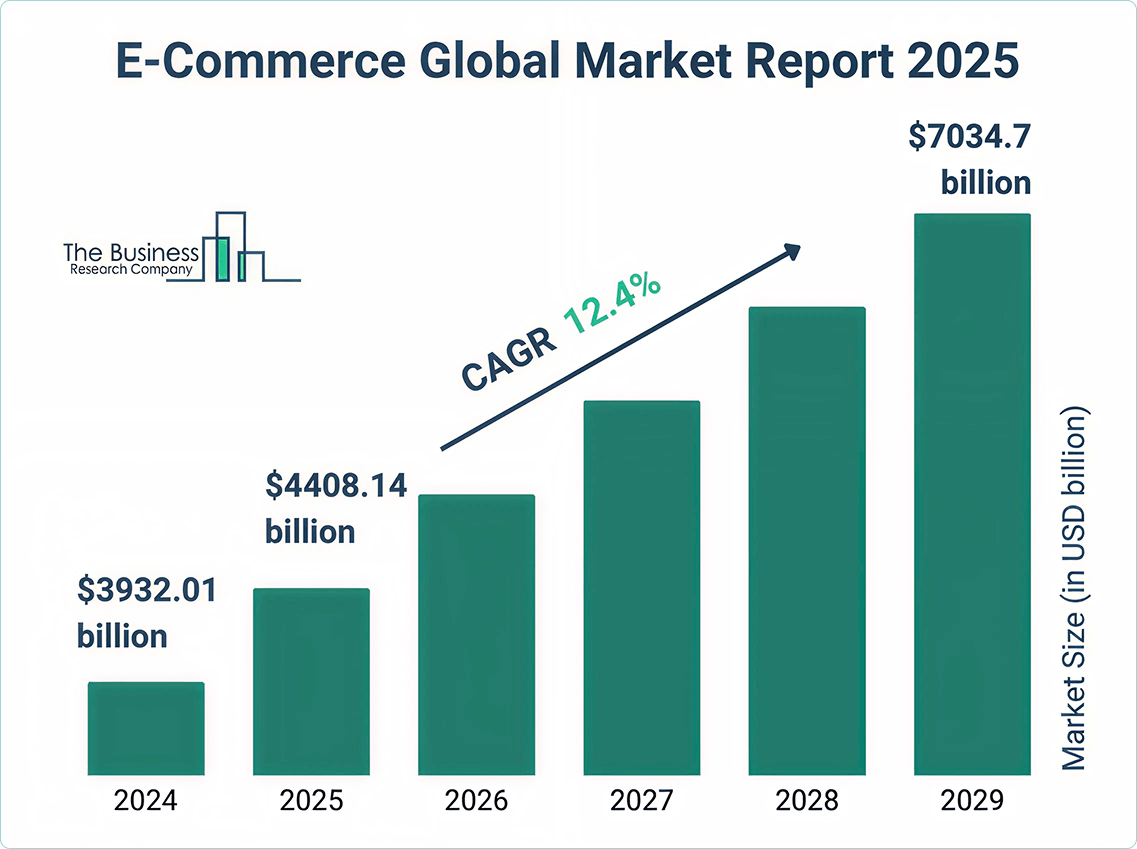
Source: https://www.thebusinessresearchcompany.com/
Indeed, the importance and influence of the e-commerce market in modern business and technologies is unquestionable. The Covid pandemic of 2019-2021 only stimulated retail operations provided via the Internet. However, such rapid growth inevitably led to a number of problems and direct contradictions, from primitive online shopping difficulties to global retail challenges.
We talk not only about common competition between companies, but also about conflicts between companies and consumers. These conflicts are the reason for a few concerns that e-commerce and online retail companies are going through right now.
In this blogpost we’ll have a look at these challenges, showing that most of them have objective preconditions and there’s hardly possible to point at someone guilty. Nevertheless, we still find it possible to provide some ideas and recommendations on how to improve your e-commerce capabilities.
Exploring the Main Challenges of E-commerce
Most of the research, reports and studies made on the topic for the past years have highlighted a few common problems that the e-commerce industry faces.
We decided to look at these problems from different angles, considering the positions of both companies and large consumer audiences.

The Problem of Cart Abandonment
The first problem is probably one of the oldest, as it started almost immediately after the beginning of mass online retail. Cart abandonment is a situation when the customer adds the goods into their online shopping cart but leaves the online store without making a purchase. In most cases the goods remain in the cart for weeks and months after, and the purchase is still not made.
According to surveys made by Statista and XP2 Learning Center by Dynamic Yield, for the period of May-June 2025 around 70-76% of online shopping carts have been abandoned by their owners. These rates cause serious concerns among e-commerce and online retail companies, but there are several facts that explain the condition.
First, not every online store visitor is truly in search of a product to purchase. There are many people who seek inspiration, explore new brands and products or look for gifts ideas through various marketplaces. Furthermore, lots of consumers tend to compare prices between products across websites or spend their free time just window shopping.
The last tendencies are directly connected with the prolonged economic crisis that directly inflicts the purchasing power of population all around the world. The above-mentioned statistical sources implicitly prove it. For example, Statista indicated that the cart abandonment rate growth starts in 2008 and stops only by 2014 (though the number is still slowly increasing).
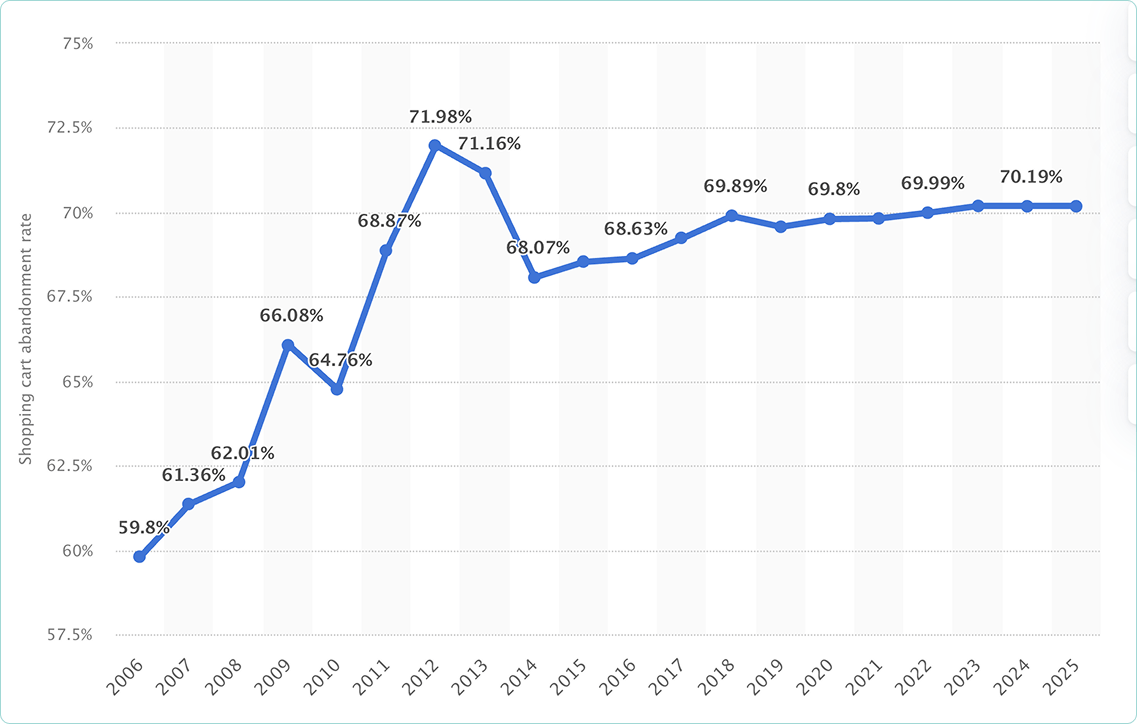
Source: https://www.statista.com/
This is the point where the global economic crisis started and proceeded for years, with the new ‘blast’ appearing in 2019 because of the Covid-19 pandemic.
Another example is XP2 Learning Center report indicating that the segment of Luxury & Jewelry demonstrates the highest cart abandonment rate of 82.28%. It means that more than 8 of 10 marketplace and online retail visitors can’t afford to immediately buy the good they chose.
In addition, the same report provides a few more reasons for the global tendency of cart abandonment:
- 55% of shoppers abandon carts due to unexpected fees like shipping costs.
- 21% users abandon the store website due to the complicated and unpleasant checkout experience.
- 17% of consumers consider lack of trust as cause for abandonment, fearing credit card theft or other security concerns.
The last two points are the problems that can be solved through various e-commerce development solution practices.
For example, the problem of users abandoning the store because of the poor checkout experience can be solved through consistent and properly organized web design. The main goal here is to build a website or app navigation systems that would not lead visitors to get stuck. We have thoroughly discovered the principles of good design in the blogposts dedicated to UX and mobile-first design topics, so we would only mention that one of the best methods is to relieve the user from unnecessary work.
From the point of functionality and design you can do the following:
- Avoid unnecessary forms. It’d be better not to make the user fill multiple information fields to make a purchase.
- Highlight key elements. All the vital buttons and links should be clearly visual.
- Make the interface simple and familiar. You should use standard web design practices, as the new creative approach can repel users and lower the chance of them making a purchase.
One more solution is the implementation of predictive analytics features. There are many ways how the advanced analytics can be applied for solving the problem of cart abandonment:
- AI-powered risk prediction and scoring. A special AI tool can be implemented and fine-tuned for tracking user behavior (clicks, browsing time, past purchases). The data can be used for predicting and scoring the possibility of user abandoning
- Predicitve recovery campaigns building. The data got within the risk prediction and scoring process can serve as the basis for mitigating the problem. For example, high-risk users can immediately receive a discount or free shipping offer. At the same time, low-risk users may receive social-proof notifications. All these minor solutions can be set and fine-tuned for autonomous work through the usage of machine learning techniques.
- AI-powered ‘Next-Best-Action' system. One of the most advanced predictive analytics solutions, leveraging the reinforcement learning techniques. It not only provides common recovery actions (for example, personal discounts) but learns which intervention performs best for similar use cases. For example, it could be a 10% discount for one customer and 20% discount for another.

Delivery Expectations
Next problem relates to the speed and quality of products delivery. The current tendency noticed among most of the e-commerce and retail companies is that they try to ensure the fastest delivery possible. However, the statistics say that these days speed is not so crucial for consumers.
According to the report made by McKinsey shows that the past years have been marked by a great shift of consumers' attention from speed to flexibility.
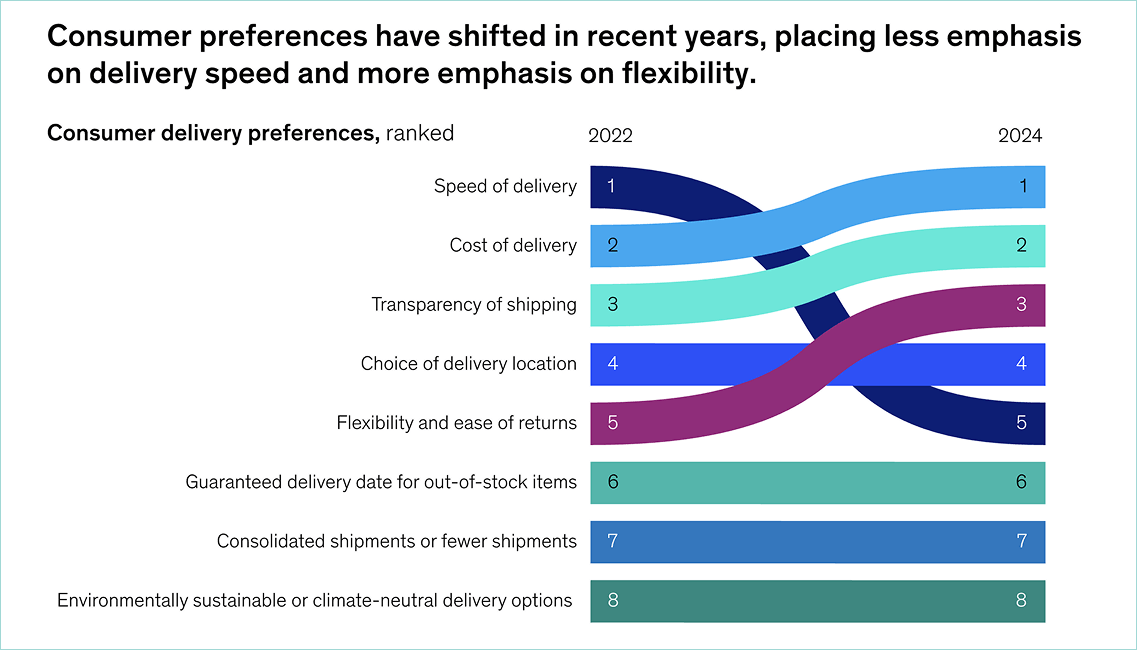
Source: https://www.mckinsey.com/
As we see, the delivery costs and shipping transparency also rose in value. These facts are easily correlated with the problem of shopping carts abandonment and in essence have the same nature.
The total financial insecurity of most of the consumers makes the capabilities of saving money more valuable than the possibility of receiving the product fast.
The same report by McKinsey indicates that 90% of buyers are ready to wait no less than 3 days, especially when the delay can reduce shipment costs.
However, this fact doesn’t mean that companies have to neglect the convenience and speed of delivery at all. To be precise, retail companies should pay close attention to fulfilling their delivery obligations.
According to McKinsey, consumers place higher value on items being delivered within the promised arrival window or by the promised arrival date than on actual speed of delivery. The following charts demonstrate how easily customers lose patience when the delivery time exceeds their expectations.
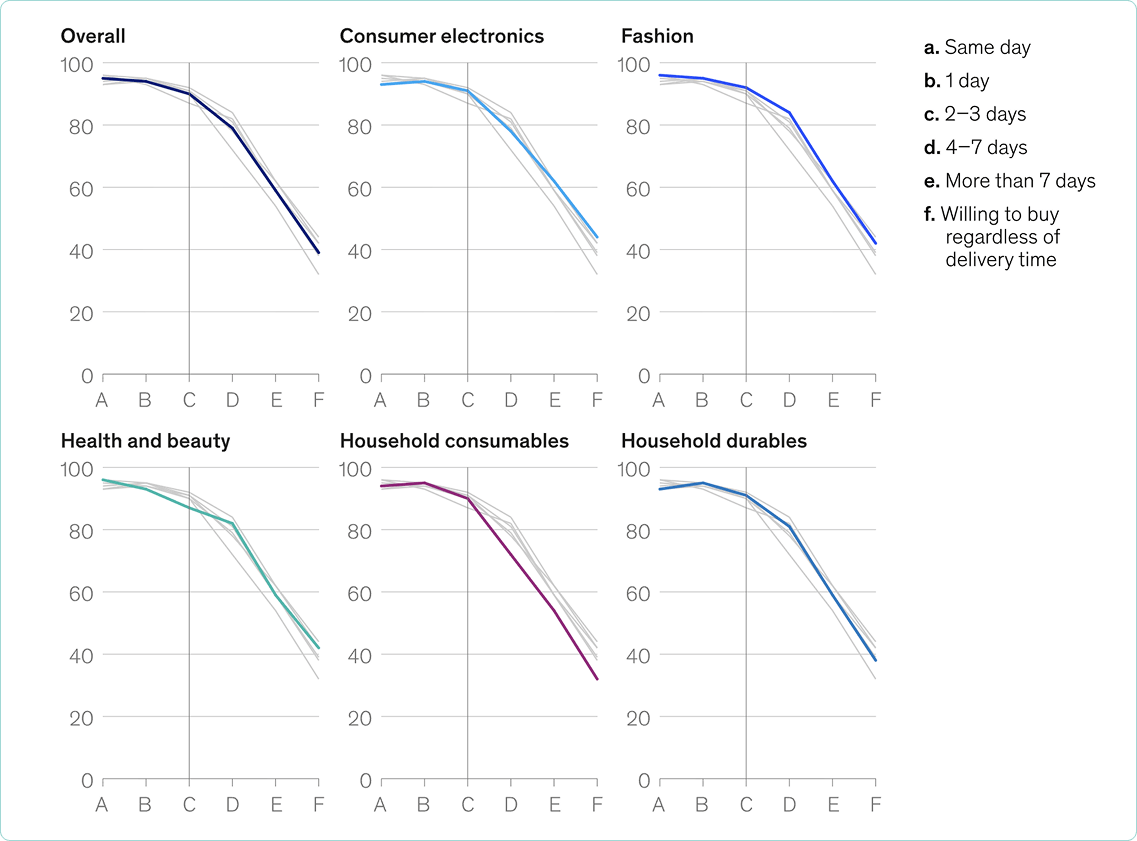
Source: https://www.mckinsey.com/
Even though we can’t help you improve your delivery and transport facilities, we can advise on how to work with user expectations through your website or app.
In June 2023, Baymard Institute conducted research on retail and e-commerce websites UX. The main idea was to check how the presentation of delivery dates influences user satisfaction.
According to the research, 41% of the websites use ‘delivery speed’ instead of ‘delivery date’ which negatively affects the user experience. As the institute says:
‘Participants presented with only the shipping speed or shipping name often came to a full stop as they considered information that was unclear, unstated, ambiguous or widely varying from site to site.’
At the same time, exact delivery date has proved itself as an efficient method of relieving the users from unnecessary work.
‘They won’t need to be concerned about the order cutoff day, whether there are any holidays coming up, whether any of the available delivery methods deliver on Saturdays or not, whether the site has any order-processing time, how long order processing might take, or whether the site’s internal cutoff time for processing orders has passed or not.’
Apart from the enhanced user experience, the technical e-commerce development solution for the false delivery expectations problem lies in an informing system optimization and order management system (OMS) creation.
For example, it is possible to implement an ML-based tool that will automatically analyze the current delivery conditions (weather, traffic, transport and warehousing workload). That will be possible thanks to the integration with APIs of other popular services (for example, Google Maps). Through that, it will automatically correct the final delivery date.
Sich a solution should be accompanied by a proactive order status notification system. As the engine tracks any changes, the customer must be immediately notified about the delivery date shifts.
Furthermore, a more advanced technical solution will allow not only to track the conditions and notify about changes but also provide possible delivery rerouting options.

Improper Inventory Management
Problem №3 refers to the capabilities of retail companies to provide the consumers with the goods they need along with the abilities to monitor and analyze sales and purchases.
In addition, inventory monitoring is about tracking stock levels and e-commerce company abilities to automate routine low-level tasks.
Through that, improper inventory management leads to the following problems:
- Frequent ‘out-of-stock' and ‘overstock’ situations in warehouses and offline stores.
- Disorganization in both purchases control and products stocking.
- Low level of employees’ productivity, as they spend most of their working hours on low-level manual operations.
The result is total downfalls in retail efficiency and customers' overflow.
There are many ways of improving retail business positions on inventory management, from stricter control over workers to full-scale e-commerce development solutions like retail management system implementation.
There are several of them considered basic and crucial.

Intelligent standardization
The point that is crucial for organization of products in warehouses and their transportation, purchasing, returning and much more. Standardization practice includes proper naming and categorization along with the defining of storage timing and conditions, shipment and ordering processes description.
In other words, standardization is about creating an overall system of e-commerce companies dealing with their products for quicker access to them and more efficient work on them.
Predictive analytics for stock management.
A solution primarily aimed at optimization of stocking. The usage of AI-based tools for analytical purposes allows to monitor and analyze purchasing and ordering tendencies, identifying the peaks and downfalls. The data can show the customers' need for certain products within certain time periods. Through that, retail and e-commerce companies can forecast and plan their shipment and procurement strategies.
The usage of AI-based predictive analytics is an intelligent, explicit and efficient way of avoiding ‘out-of-stock' and ‘overstock’ problems.
AI agents and AI-based monitoring
The solution that can perfectly fit the needs of employees' efficiency monitoring and optimization. AI agents are advanced AI tools and programs able to work on task-specific sophisticated operations with minimal human intervention. Through that, AI avatars can be used in operations monitoring to look after the efficiency of employees. It’s not about primitive control – AI agents can track weak spots and recommend possible ways on how to automate time-consuming primitive operations. In essence, they can work in this automation themselves.
All the above-mentioned positive changes can be achieved only via ever-scaling digital transformation of the inventory management sphere. And this transformation is already proceeding.
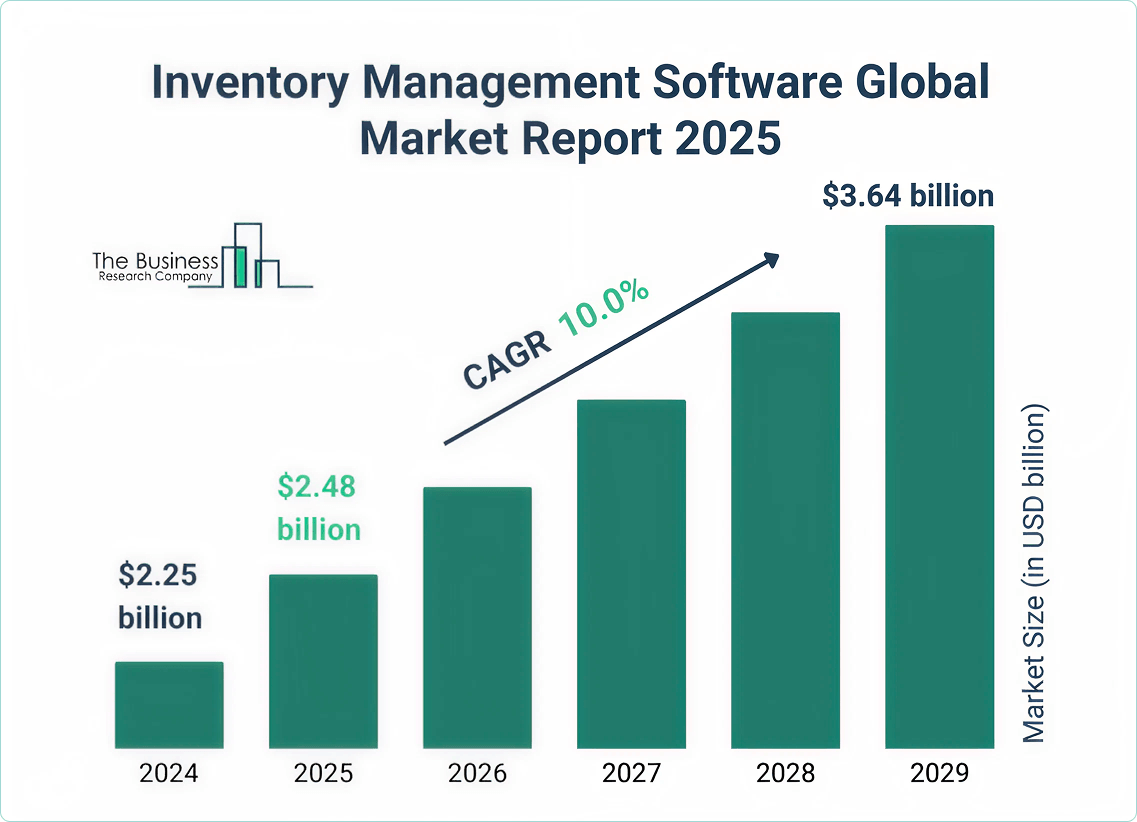
According to Business Research Company, inventory management software market size reached 2.5 billion USD in the beginning of 2025, and the annual growth rate is estimated to be no less than 10%.

Customer Retention and Loyalty
Customer retention is another challenge for e-commerce companies and retailers.
The problem of ensuring customers' loyalty is not new, but it has been disturbing the industry for years and decades, even before retail started shifting to digital.
In essence, it’s hard to overcome the rather primitive but still unbeatable logic of consumers – if the same product is available elsewhere for a lower price, they’ll buy it there.
So, how could e-commerce companies prevent buyers from going to competitors, to offline stores or even from private purchases made bypassing any taxation or business income?
Of course, it can just lower the prices of their products. This option, being the easiest, sets lots of milestones, including the possible unprofitability and further ‘response’ of the market. Through that, it is better to apply to other ways aimed at business promotion.
Customer loyalty programs setting
Modern customer loyalty programs should go beyond simple point systems – its goal now is to ensure strategic long-term relationships between the retailer and the client.
In doing so, they can rely on exclusive discounts, early access to sales or free shipping thresholds. Altogether, these methods can ensure repeated purchases and encourage higher spendings.
The traditional referral marketing can also be a good method, as customers can earn credits or extra offerings for bringing in new buyers.
Content marketing
The strategy of customer retention via content marketing is sophisticated and includes tens of miner and larger ways of attracting users via content.
Text and video blogs describing the strengths of your products, news referring to new trends or reviews and unboxing Instagram and TikTok videos – all of them contribute to the final outlook of your e-commerce business and make clients stay with you to get more content.
Permanent monitoring for customer behavior
One more method is closely connected with the analytics practices of your retail business. The analysis of how customers interact with your company is one of the methods of how you can influence their needs. And this process can be also automated.
For example, you can apply for software that would analyze the clients' intentions through the usage of NLP technology. The software would be able to automatically identify the emotional color of the requests made via various communication channels (email, social media, website).
Through that, the company’s specialists could immediately see the format of the message, being ready to mitigate negative situations, if necessary. As a result, the customer, already irritated by his complaint, gets all the necessary help within a small period, which raises the level of their satisfaction while dealing with the procurement company and its customer support service.
AI-based loyalty-related decision-making
Starting a customer loyalty program or launching a new content campaign are the actions that imply thorough consideration of all the ‘fors’ and ‘againsts’. Through that, the company will need trustworthy data for proper customer loyalty-focused decision-making.
We closely investigated the prospects and state of AI in decision-making in one of our previous blogposts. However, in the context of solving one of the e-commerce challenges, the usage of analytical capabilities will be necessary.
For instance, the typical user behavior information, the format of requests they send or the channels they come from is a firm basis for understanding what actions should be made. Perhaps, you would decide to promote more for the particular customer category, or intensify content publishing on the social media that are most popular among your clients, or even replace some of the customer support employees?
The AI-based data processing and analysis, if properly fine-tuned, will make the decision-making process easier and the customer retention policies more efficient.
But why would an online retailer pay so much attention to ensuring old customers’ loyalty instead of putting all their effort into finding new leads?
According to the insights provided by DemandSage retaining customers is 5 times cheaper than acquiring new ones. Through that, working on customer retention implies working on company’s costs reduction.

Returns and Reverse Nightmares
Problem №5 is another burden that lies on e-commerce companies' logistics.
For example, the National Retail Federation indicates that in 2024 total global returns in e-commerce and retail industry reached 890 billion USD.
However, businesses should understand that a 100 percent decrease in returns is impossible to achieve. In many cases, returns are not the company's fault. The customer could have found a defect after the purchase, the product could not align with clients’ expectations, or they just could find a less expensive analogue.
Moreover, the same statistics from the National Retail Federation declare that 76% of consumers consider free returns as one of the key factors for buying in a particular place.
Through that, we’d recommend focusing not only on how to reduce the number of returns and reverse to a minimum. As we indicated, a high-quality product is the best way to stay competitive, while some factors lie beyond a single company’s capabilities (like lower prices among competitors). Our recommendation is to focus on the convenience of return, reverse and refund processes.
The client should clearly understand:
- What types of returns are allowed?
- What are the time limits?
- What are the return shipment costs?
- What are the ways of asking for a return and refund?
Though clear information about return policies can’t guarantee the decrease in total number of orders canceling and refunding, it allows the client to know what exactly they’re in after making a purchase. As a result, it raises the level of trust that customers put into retailers.

Common Distrust to Retailers
The problem of trust is rather new for the e-commerce industry. Indeed, companies had to prove the quality of their product and the transportation of their policies, but distrust became a real problem just a few years ago.
The problem is an anticipated reaction to fake customer reviews or improper quality of goods and services. Companies produce more and try to sell more using all possible means, even those that violate ethical and traditional commercial rules. Such practices face logical dissatisfaction from consumers.
In March 2025, the European Commission published a report regarding consumers' attitude to retailers and companies providing goods and services online. The report is based on the Consumer Conditions Survey of 2024.
Except positive tendencies with around 70% of European consumers feeling confident about the quality of products and protection of their consumer rights, there are also several unpleasant facts for e-commerce companies.
- Online shoppers are over 60% more likely to experience problems with their purchases, compared to those shopping offline.
- 45% of consumers encountered online scams, and many experienced unfair practices, including fake reviews and misleading discounts.
- 52% observed a sufficient decline in products quality without a corresponding price drop.
While EU governments are planning to announce new initiatives for the forthcoming years, businesses can put extra effort into raising trust.
Shopify is one of the many companies engaged in the e-commerce industry who researches the industry trying to find solutions for lots of its challenges. Taking into account considerations and suggestions provided by Sharma Brands brand agency and its CEO Nik Sharma, Shopify recommends paying more attention to social proof establishment.
In essence, Nik Sharma advises relying on individual influencers and bloggers than on marketing agencies that charge dozens of thousands for advertising campaigns.
This point is rather controversial, as recent years have demonstrated the increased distrust of influencers as well (as some of them were part of fake reviews e-commerce campaigns). However, the report made by Reuters Institute in June 2025 says that the growing dependence on social media, video platforms and online aggregators is observed.
The reason for this is that most of the influencers and bloggers seem ‘casual’ and ‘natural’ for most consumers, if compared to the images translated on TV or mass events.

Mobile Optimization Problems
One more challenge that appeared in the industry in 2000s and has been scaling till this very moment.
Now, in 2025, optimizing websites, apps and online stores for mobile is a must-have condition for successful e-commerce positioning.
According to July 2025 statistics by Data Reportal, 70% of world population use at least one mobile device, while 97,5 % of Internet users aged 16+ own a smartphone.
These numbers demonstrate that mobile users play a crucial role in online shopping. In addition, the research made by Google the end of 2024 indicated that 53% of shoppers abandon sites that take longer than 3 seconds to load on mobile and 60% of consumers see the unpleasant mobile experience as a factor for rightfully switch to a competitor. Through that, e-commerce companies in 2025 should cover several mobile optimization pain points.
- Simplified checkout systems. One-click checkouts, digital wallet integrations (Apple Pay, Google Pay) and guest checkout options should become a must-have practice for the companies intending to sell to active mobile users.
- Mobile-first design. A design approach that we thoroughly discussed in one of the previous blogpost. It is a set of design rules and practices (like text, links and button alignment) that make platforms, apps and websites convenient to use on mobile by putting mobile phones in first place while design and functionality planning and prototyping.
- Filling the SEO gaps. The method that should work with the positioning of an online retail company or a marketplace in search systems. For your mobile app or marketplace to be properly indexed on Google, you must deal with structured data markup, Core Web Vitals optimization and dynamic serving for device-specific content.
Conclusions
The e-commerce industry continues to grow at an unprecedented rate, projected to reach $8.75 trillion by 2030, but this expansion comes with significant challenges. From cart abandonment and delivery expectations to inventory mismanagement, customer retention, costly returns, trust issues and mobile optimization gaps, online retailers face complex obstacles that require strategic solutions.
While some challenges stem from economic factors (like purchasing power declines) or consumer behavior shifts (preferring flexibility over speed), others can be mitigated through technology and smart work with user experience. AI-driven inventory systems, seamless checkout flows, loyalty programs and mobile-first optimization – all these methods can ensure a rise in e-commerce companies' attractiveness to consumers.
E-commerce in 2025 is going through a number of problems, some of them lying beyond the capabilities of a single company or group of companies. However, their success still demands adaptability. By leveraging data analytics, automation and customer-centric strategies, businesses can turn these challenges into opportunities for reducing costs and boosting retention.
And if you need tailored tech solutions for your e-commerce operations, Silk Data is ready to put maximum effort and leverage its vast expertise to help!


















Our Solutions
We work in various directions, providing a vast range of IT and AI services. Moreover, working on any task, we’re able to provide you with products of different complexity and elaboration, including proof of concept, minimum viable product, or full product development.