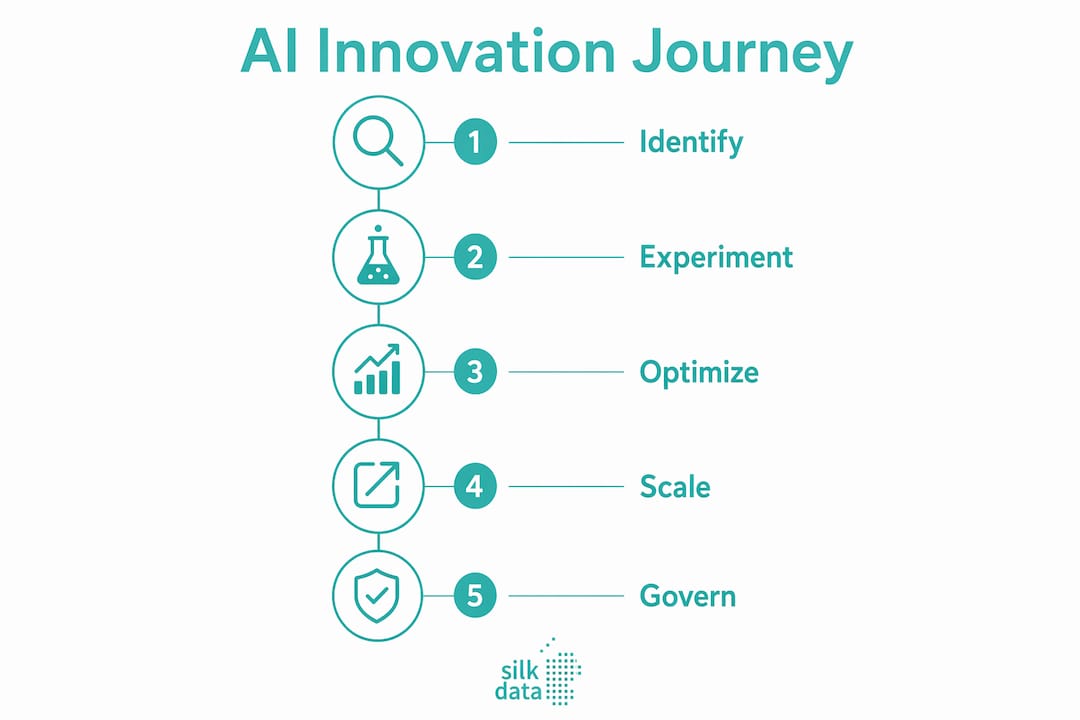
Most companies deploy AI somewhere in the building. Few get corporate innovation out of it. The role of AI in innovation looks obvious in slides and hard to prove in the P&L. The McKinsey State of AI survey puts the gap clearly. A large majority of organizations use AI in at least one function. Only a small share scale it to measurable financial value. The problem is rarely the model. It is the operating model around it.
This guide is for corporate leaders and innovation managers who already know what AI can do in theory. The question is how to make it produce a different P&L, not a different slide. Written with input from Polina Volodina, AI Advisor, and Yuliya Marazenko, Head of AI Implementation at Silk Data. Based on 200+ AI deployments across FinTech, EdTech, publishing, and manufacturing.
How AI Actually Drives Innovation Performance
AI-driven innovation lifts output up to a threshold and then flattens. A 2026 peer-reviewed MDPI Systems study of 25,204 Chinese manufacturing firm-years found an inverted-U pattern. Returns peaked near an adoption score of 2.948, then declined.
The mechanism behind the decline has a name: homogenization. When every team trains on similar data with similar models and similar prompts, the outputs start to look alike. Differentiation, the whole point of corporate innovation, quietly erodes. The defense is architectural — a custom model approach using your proprietary data changes what the model can produce, in ways that off-the-shelf tools cannot match.
There is a second variable that matters more than most boards admit: absorptive capacity. Two firms can buy the same models. The one with cleaner data, better documentation, and people who can read model outputs critically will extract several times the value. The other will get a dashboard.
So there is a real trade-off, and a workable AI innovation framework has to name it. Push AI adoption too gently and you leave efficiency on the table. Push it as a blanket mandate and you flatten the variety of ideas your innovation function depends on.
| AI adoption level | Innovation outcome | Primary risk |
|---|---|---|
| Below optimal | Underuse, slow cycles | Missed efficiency gains |
| Near optimal | Peak novelty and speed | Needs active governance |
| Above optimal | Diminishing returns | Homogenized ideas, lower differentiation |
A practical signal: track idea variety across teams, not just throughput. When the briefs your AI-assisted teams produce start to sound interchangeable, you have crossed the line.
Where innovation with AI still requires humans first:
- R&D compression. AI-augmented literature search, patent analysis, and hypothesis generation cut the "understand what's known" phase of R&D from months to weeks.
- Concept-to-prototype cycle. For digital products, AI code generation and design tools compress prototyping from days to hours.
- Market signal absorption. AI monitoring of patents, filings, and academic literature surfaces adjacent competitive moves earlier than manual scanning.
- Cross-functional idea synthesis. AI-assisted synthesis of customer feedback, sales data, and product analytics produces innovation briefs that used to require weeks of committee work.
Where innovation still requires humans first:
- Category-creating bets. The kind of leap that redefines a market never comes from synthesis of existing signals. AI is good at incremental. Humans are still where discontinuity happens.
- Customer discovery early-stage. Talking to real customers to understand pain, motivation, and unmet needs. AI summarises transcripts. It does not replace the interview.
- Cross-domain analogies. Innovation often comes from applying pattern from one domain to another. Current AI systems are weak on cross-domain transfer.
Why Most Companies Pilot Forever (and What to Fix)
A working AI innovation strategy stalls at scale because AI gets bolted onto fragmented systems and unclear decision rights. Not because the model is wrong.
We see the same pattern across our case studies. The pilot works in a notebook. Then it has to read from four databases, write into a fifth, and someone has to decide what "the model recommended X" means for next Tuesday's pricing call. That is where projects die.
Three practical moves matter more than buying another platform:
- Audit the data path before the model. If the model needs data from systems that do not talk to each other, integration is the project. In our work, data preparation takes 50-65% of total effort on a serious build. Vendors who hide that are setting you up for a stalled pilot. If you are wrestling with how to structure the data layer for AI programs specifically, our guide on data strategy for AI covers what actually blocks pilots at scale.
- Assign a business owner to every model. Not a data scientist. An operator who carries the P&L the model touches and has the authority to act on or override its outputs. No owner, no production.
- Treat AI-assisted ideation as a hypothesis machine, not an answer machine. Innovation is one of the few functions where the cost of a wrong idea (a project that failed) is much smaller than the cost of a right idea missed (a market opening a competitor took). This asymmetry changes how AI should be used. Models are excellent at generating and clustering hypotheses. They are unreliable at judging which hypotheses matter. Design the workflow so AI expands the option space and humans compress it. Reversing that order - humans generating, AI filtering — usually collapses variety to whatever the model has seen most often.
Polina Volodina, AI Advisor at Silk Data, frames the trade-off this way in feasibility reviews. The organization has to be ready to act on probabilities without flinching. If the business cannot, the model will not save it.
How CEO Leadership Shapes AI Innovation Outcomes
AI capability lowers innovation failure risk only when the CEO actively coordinates digital priorities and the top team has real digital literacy. A 2026 Nature Humanities and Social Sciences Communications panel of 3,829 high-tech manufacturing firm-years found that without that combination, AI capability alone did not reliably reduce failure.
What integrative leadership means for AI innovation management in practice is unglamorous:
- AI investment decisions sit on the same agenda as product strategy, not in a separate "digital" review.
- Functional VPs share a model registry and know which models other functions are using.
- The CEO can name, without prompting, the two or three AI bets the company is making this year.
The downside is honest. It is slower. Cross-functional alignment costs meetings. The upside is that the few bets you make get owned, funded, and shipped. Many AI portfolios fail not from bad models but from twenty half-funded experiments with no senior owner.
Trust, Data Quality, and the Cost of Over-Trusting the Model
Calibrated trust outperforms high trust. A 2026 Nature Scientific Reports survey of 269 innovation found an inverted-U relationship between trust in AI and digital innovation outcomes, meaning moderate trust improved outcomes while over-trust degraded them. Over-trust drove automation bias. Teams stopped checking, errors compounded, and bad decisions shipped faster than good ones.
| Trust level | Human verification | Innovation outcome | Primary risk |
|---|---|---|---|
| Low | Excessive, every output reviewed | Slow, underuses AI | Bottlenecks, lost speed |
| Calibrated | Risk-weighted checkpoints | Best balance of speed and quality | Needs active governance |
| Over-trust | Low or absent | Degrades over time | Automation bias, error propagation |
Two practical things help teams stay in the middle column. First, data quality good enough that errors are visible. The agritech work we did on animal survival prediction surfaced an input record listing an animal at "several dozen tons." The model would have happily used it. A human caught it. The standard is simple. Errors should be catchable. Catching them should be someone's job.
Second, intellectual capital. People with enough domain depth to challenge a recommendation rather than defer to it. A junior team trusting an early model would have shipped confidently wrong predictions. A senior team trusts the model only inside the range where it has been tested.
If you operate in the EU and your innovation use case involves personal data or sits in a high-risk category, GDPR and the EU AI Act set the floor for what calibrated trust has to look like on paper. Those are separate compliance tracks from the technical ones. Do not mix them in the same workstream.
How to Scale AI Innovation Without Stalling
- Scope a real problem with a number attached. "Cut exam review time" is a wish. "Cut exam review time by 60-80% on this submission type" is a target. On the Plagiarix work with APT in education, the target was clear and we hit 90% reduction in review time. Without the number, no one knows when to stop.
- Run a PoC in roughly three months. Scoping, prototype, go or no-go. If a vendor needs a year before showing anything that runs, the risk is on you, not them.
- Use an SME from day one. The model needs someone from the business who can say "that label is wrong" and "this edge case matters more than that one." Without an SME, you build a plausible model for the wrong problem.
- Decide deployment early. Cloud is faster. On-prem keeps regulated or sensitive data inside the perimeter, which matters for legal archives, marketing data, or anything covered by GDPR. We have shipped both. The choice is not ideological. It follows the data. Our guide on choosing an AI development tech stack walks through the trade-offs in more detail.
- Plan for monitoring before launch. In AI innovation management, models drift and the ones that go unwatched drift furthest. The marketing agency we built a local LLM for kept the model inside their platform partly so they could watch it. Visibility is half the value.
Yuliya Marazenko, who leads AI implementation at Silk Data, puts the engineering reality plainly. Most innovation failures we are called in to fix are not model failures. They are integration failures, ownership failures, or a refusal to admit the data was not ready. The model performed as designed. The organization was not.
AI innovation readiness checklist Before your next AI innovation investment, verify:
- Data path is mapped end-to-end for the target workflow
- Business owner named with authority to act on model outputs
- Success metric defined with a target number, not a wish
- SME committed from day one, not brought in at launch
- Deployment mode (cloud or on-prem) decided by data sensitivity
- Monitoring plan drafted before production
- Idea variety metric in place, not just adoption metric
- CEO can name the two-three AI bets the company is making
Where Silk Data Fits
If your team is past the "is AI useful" question and stuck on "why does our AI not produce anything we can scale," the work usually sits in three places.
- Feasibility and roadmap. A structured assessment that maps candidate use cases to your data reality and organizational readiness, before you commit budget to any of them.
- Custom model development against your real data, with a business owner named from day one and an SME involved from the first sprint. The goal is a model that ships to production with a defined role in a workflow, not a prototype that sits in a notebook.
- Deployment that respects how your business runs, including on-prem where the data or the regulations demands it. Cloud is faster; on-prem is safer for regulated data. We build both.
If you want a second opinion before committing budget to your next AI innovation bet, that is exactly what our consulting engagements are for.