
Expert’s Thoughts

"Once again, we are coming back to JavaScript and carry on considering the prospects and capabilities it provides both for developers and businesses. It’s time to talk about the programming language inspired by JS and which is now conquering more and more community’s admiration.
In this blogpost, however, we don’t narrow the topic to primitive ‘TypeScript vs JavaScript’ model. Considering the vast experience of Silk Data’s web developers, we’d like to show that there’re cases when the one language is more preferable than the other."
Yuri Svirid, PhD. — CEO Silk Data

A Few Words About JavaScript
For almost thirty years JS has formed the backbone of web development , and now it’s hard to point out a website that isn’t based on it. Let’s have a quick look at the history of its success.
JavaScript first appeared in 1995, as an initiative from the developers by Netscape, a US-based computer service corporation, owner of web browsers series named Netscape Navigator. The idea was to create ‘language for the masses, to help non- programmers create dynamic and interactive websites’ with the aid of experienced and widely known programmer Brendan Eich.
However, the first years were far from being successful, as JS was efficiently overrun by JScript, an interpreter (i.e. software aimed at executing encoded logic) developed by Microsoft after Internet Explorer’s release in 1995 . Microsoft’s and, consequently, JScript dominance lasted for 10 years with 95% of market share was owned by Internet Explorer.
Everything changed in 2005 when groups of open-source community enthusiasts released and described a set of technologies for web apps creation, where JavaScript was a backbone. When Google released its Chrome browser in 2008 with a JS engine, the language’s popularity started dramatically increasing. It was followed by Node.js release in 2009 that enriched the usage of JavaScript outside web browser development.
However, it’s not the history of language that attracts the most, but the development capabilities and following business benefits it provides. There are several features that make JS so popular.

Prototypal Inheritance
A unique and powerful object-oriented programming model. Instead of using classes, objects can directly inherit properties and methods from other objects. It means that developers get an incredibly flexible and dynamic way to share and reuse code between objects.
At the same time, business benefits from extending functionalities for the existing products. Developers can add new properties or methods to a prototype, and all objects linked to that prototype instantly inherit them, even after they've been created.
First-class Functions
It’s a JS specific that allows to treat functions like any other value. They can be assigned to variables, passed as arguments or returned from other functions. In essence, the developers can simply tell the JS what they want to do (through array methods like ‘map ()’, ‘filter ()’, etc.), and JavaScript does all the work.
To this we can also add the ability to build complex programs and functions through simple functions combination.
Dynamic Typing
In many programming languages (like Java or C#), when the developer declares a variable, they must also declare what type of data it will hold, and this type can’t change.
In JS variables are not bound to a specific data type. A variable can be declared with a string and later assigned with a number or an object. The fact that developers can just create variables and assign them data offers tremendous flexibility, and business gets extremely rapid prototyping and early-stage development.
JavaScript as an Interpretive Language and JIT Compilation
JavaScript is an interpreted language, meaning it executes code line by line without needing a prior compilation step. You can save your code and immediately refresh the browser to see the changes, leading to a very fast and tight feedback loop for developers.
At the same time, modern JS engines (like V8 in the above-mentioned Chrome) use JIT (Just-In-Time) compilation to analyze and optimize code as it runs, achieving performance near that of compiled languages.
As a result, developers using JavaScript get the best of both worlds: the quick iteration speed of an interpreted language and the high performance of a compiled language. They don't have to choose between developer productivity and application speed.
Silk Data demonstrates vast experience in running and supervising JavaScript projects of various scales and complexity. From NLP-based tools for automated question generation and intelligent news articles analysis to complex digital platforms for content publishing and interactive onboarding of employees – we have enough knowledge to build any solution.
What is TypeScript? The Key Features of the Language
TypeScript is a programming language designed by Microsoft and released in October 2012, aimed at adding static typing to JavaScript. Since the initial release, the language has gone through numerous major updates with regular new features added to improve developer experience. The main purpose of TS creation was to bypass the shortcomings of JavaScript in building large applications. In doing so, TypeScript relies on the following set of features.
- 1
Type Annotations
It is the fundamental feature for comprehending TypeScript meaning, and it differs the language from JS. Unlike in JavaScript, type annotations in TS allow to explicitly state what type of value a variable, function parameter or return value is expected to hold.Benefits for Developers
- Early error detection. The system quickly catches type mismatches dynamically, as the coding goes, and not when the developer runs the program.
- Self-documenting code. The code itself tells what it expects, so the developer doesn’t have to guess what a function needs or returns.
- Superior IDE support. It enables powerful editor features like autocompletion, intelligent refactoring and safe renaming (as the tooling knows the shape of your data).
Benefits for Business
- Fewer bugs in production. As the system catches a huge class of common errors before they ever reach the user, companies get more stable and reliable applications at the release point.
- Reduced debugging time. Developers spend significantly less time hunting down `undefined property` errors, which implies faster development and lower maintenance costs.
- Easier onboarding. Easier onboarding. New developers can understand the codebase much faster because the types themselves can act as built-in documentation.
- 2
Generics
It is a tool for creating reusable and flexible components that can work with any type, while still maintaining that type's integrity. It's like creating a blueprint for a function or a class.Benefits for Developers
- Reusability without additional writing. You can write one function that works for all types, but unlike using `any`, you still get full type safety and autocompletion.
- Type safety in flexible code. Essential for building libraries, utility functions and data structures (like arrays, promises, etc.) that need to be broadly useful but type-safe.
Benefits for Business
- Maintainable codebase. The feature drastically reduces code duplication which implies a clean codebase. Developers can write a single, well-tested generic function instead of multiple specific ones.
- Futureproofing. New data types can be used with existing generic functions without any modifications, making the codebase more adaptable to change.
- Leverages existing code. Generics encourages the development of a central library of utility functions that can be safely used across the entire project. As a result, specialists spend less time on information searching and transferring.
- 3
Enumerated Types
It is a way to define a human-readable set of named related constants. This gives a name to a numeric or string value. In essence, the developer defines an `enum` where the values are, by default, auto-incrementing numbers (but can also be strings).Benefits for Developers
- No more ‘magic values’. There is no need to guess what a random number or a string literal means in a specific code entity.
- Easy to refactor. The developer can change the value in the `enum` definition, and it updates everywhere.
- Type safety. Prevents you from assigning invalid values.
Benefits for Business
- Fewer logical errors. Prevents bugs caused by incorrect or misspelled string literals (for example, `"ADMIN"` and `"Admin"`).
- Clearer domain modeling. Makes the code a direct reflection of business rules and states (for example, `OrderStatus.Pending` and `OrderStatus.Shipped`), which makes it easier for non-technical stakeholders to discuss.
- Enhanced data consistency. The feature ensures that everywhere in the application, the same concept is represented by the exact same value, which positively influences both app performance and user experience.
- 4
Namespaces
It is a legacy TypeScript feature for organizing code into logical groups and preventing naming collisions in the global scope.It works the way that you wrap code in a `namespace` block. All the data inside is scoped to that namespace and must be explicitly exported to be used outside.
Benefits for Developers
- Logical grouping. Adds convenience, as the system keeps related functionality together.
- Avoids large-scale code pollution. Prevents variables and functions from being added to the global scope, which can cause conflicts in large applications.
Benefits for Business
The main benefit that business gets from namespaces is safer third-party integrations. Usage of namespaces reduces the risk of two different libraries accidentally using the same global variable name, consequently reducing the chance for the application to break.
Note! While namespaces are part of TypeScript, the industry standard has shifted to ES Modules (`import`/`export`). These modules are considered superior because they are a native JavaScript standard, being statically analyzable (enabling better tree-shaking for smaller bundle sizes) and supported by all modern build tools. So, all new projects require the usage of the ES modules.
These are far from all the features which make TS prominent, and the cause permanent language popularity increase among the professional developers.
The Stack Overflow Tech report of 2025 indicates that TypeScript is used in any way by almost half of the professional developers, being overrun by JS and Python only. At the same time, TS outruns both JavaScript and Python by the level of public admiration (58% against 46% and 56% respectfully).
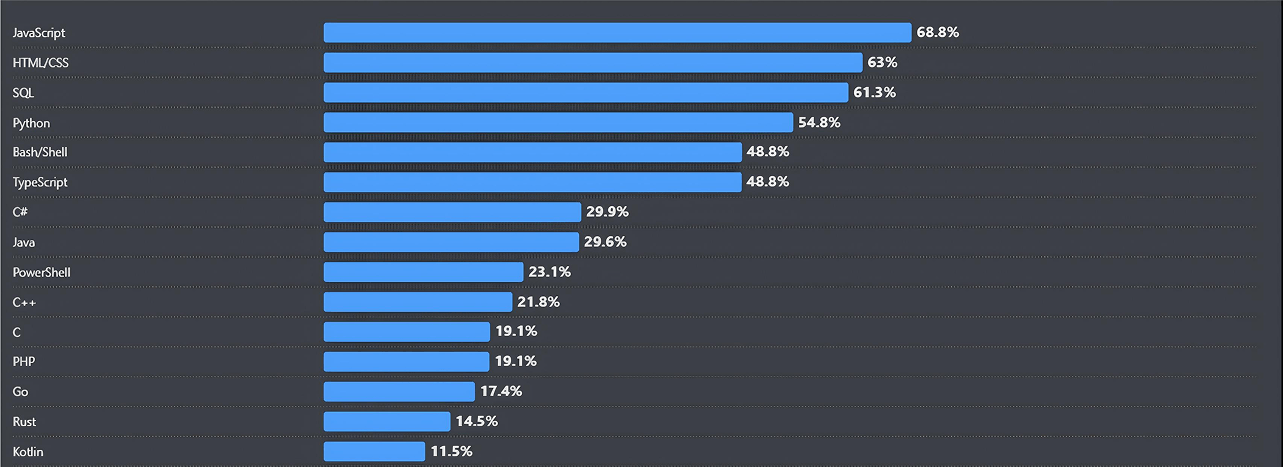
Source: https://survey.stackoverflow.co/2025/technology#most-popular-technologies-language-prof
Why Do You Need TypeScript?
Apart from being familiar with some features of the TypeScript, we will consider the common benefits that business can get from leveraging this programming language.
TypeScript Most Crucial Benefits
Precise typing system
The fact that the developer can explicitly define types for variables, function parameters and return values makes some professionals rather skeptical, as they got used to the flexibility and freedom that JS provides in this field. However, many developers and web products owners adore TypeScript for this exact feature.
The main reason is that it helps catch errors at early stages. Bugs are found instantly by the TypeScript compiler in your editor, long before the code ever runs. This prevents entire classes of runtime errors.
Easier code management
Considering the second benefit, convenient code management and maintenance are crucial for proper performance of the web application.
As the flow of data is strictly defined by its types, the code behaves more predictably, which causes less problems both at development and post-release stages.
In addition, types themselves act as live documentation. Any developer reading the code can instantly understand what data structures are expected, making the codebase much easier to navigate and understand.
Increased performance
The way TypeScript increases development performance is not in making code run faster, but in increasing coding efficiency. Its static typing catches errors during compilation in the IDE, long before runtime, eliminating entire classes of bugs.
This, combined with intelligent autocompletion, self-documenting code and safer refactoring tools, allows developers to code with more confidence and spend less time debugging, leading to a more maintainable codebase and enhanced team performance.
Advantages of Using TypeScript over JS
- Safer refactoring. If the developer wants to rename a property in a large object used across hundreds of files, they can do it with confidence. The compiler will immediately show every place that needs to be updated. In plain JS, this is a risky and error-prone process.
- Intelligent autocompletion. A feature where the developer can get accurate and context-aware functions and methods suggestions because they understand the types you're working with. It is valuable both for development and for business.
- Easier scalability. TypeScript was specifically designed for building large-scale applications. It provides all the necessary structure to keep massive codebases maintainable over time and across large project teams.
All the strong sides of TypeScript have made it an ideal tool for projects that require permanent smooth work with large amounts of data.
For example, TypeScript was the backbone of one of Silk Data’s projects regarding the development of complex marketing automation software. The solution provides a great variety of operations, including project management, analytics, reporting and planning capabilities and features (tasks division and organization, automated risks notifications, smart templating, etc.). The usage of TypeScript ensured that all the costly operations go smoothly and without sufficient performance downfalls
Bonus. When is it Better to Stay with JS?
Does all the above-mentioned information mean that all web developers should immediately switch to TypeScript? It’s not, and the reasons for why companies can’t fully rely on TS are numerous, as well as the reasons why they can’t solely rely on any other programming language in their IT projects.
Nonetheless, there are many cases, when using JavaScript would be more preferable.
In small scripts and built tools
Imagine that you need a script to rename a batch of files or a small Node.js utility for local development. In such cases, all the benefits of TypeScript's type safety are negligible and adding TypeScript is excessive.
While working with highly dynamic or unstructured data
TypeScript is certainly good at working with structured data. However, some scenarios involve data whose shape is unknown, highly flexible or controlled by an external source where defining a type becomes a problem.
At the same time, JavaScript's dynamic nature provides extreme flexibility without the need to use complex TypeScript features like extensive type assertions or any types at all.
In projects with minimal requirements
A pure JavaScript project, especially on the frontend, can often be run directly in the browser without any compilation. It means that, for example, a simple static website with a few interactive elements can be efficiently changed and updated with zero tooling. You can keep it in pure JS and edit a file, save, refresh the browser and instantly see the changes.
JavaScript vs TypeScript
The following table provides a summarization for all above-mentioned facts.
| Feature | JavaScript | TypeScript |
|---|---|---|
| Typing system | Dynamically typed, variables can hold any value | Statically typed with optional type annotations |
| Tooling and IDE support | Good support but limited to the dynamic nature of JS | Superior autocompletion, refactoring and navigation due to types |
| Code as documentation | Code intent must be inferred or documented separately | Type annotations act as built-in, live documentation |
| Ideal use case | Small scripts, prototypes, dynamic data, simple websites | Large-scale applications, enterprise projects, large teams |
Conclusions
The TS vs JS debate isn't about finding a single winner. JavaScript remains the undisputed champion of flexibility, ideal for rapid prototyping, small scripts and dynamic projects where a simple, fast workflow is paramount.
On the other hand, TypeScript shines as the strategic choice for complex, large-scale applications and large development teams, where its static types provide essential safety, maintainability and scalability.
Ultimately, the decision is rather pragmatic – choose JavaScript for its agility and minimal overhead or apply to TypeScript to mitigate long-term risk and ensure enhanced code quality in demanding enterprise environments. The right tool depends entirely on your project's specific goals and scale.
Frequently Asked Questions
It depends on the context. TypeScript is superior for large and complex applications and teams, primarily thanks to its static typing, which enhances reliability and maintainability. However, JavaScript's flexibility and lack of a build step make it more suitable for quick prototypes and small scripts.
No. TypeScript is a superset of JavaScript, and all valid JS is valid TS. They coexist, with TS being a popular choice for large-scale projects while JS remains the fundamental, runtime language of the web.
TypeScript has a steeper initial learning curve because it introduces additional concepts like static types, interfaces, and generics on top of JavaScript. However, its strictness can make development easier, especially in large projects, by catching errors early and making codebases easier to understand and navigate.


















Our Solutions
We work in various directions, providing a vast range of IT and AI services. Moreover, working on any task, we’re able to provide you with products of different complexity and elaboration, including proof of concept, minimum viable product, or full product development.