
Many business leaders still believe predictive analytics belongs exclusively to data scientists or well-resourced tech companies. That assumption is outdated and costly. Predictive analytics asks what will happen next by using historical data and statistical models, setting it apart from descriptive analytics (what happened) and diagnostic analytics (why it happened). Today, the technology is accessible, proven, and essential for any organization serious about smarter decisions, reduced risk, and sustainable growth. This guide walks you through everything you need to move from basic understanding to confident, practical application.
What Is Predictive Analytics? Demystifying the Basics
Predictive analytics uses historical data, statistical algorithms, and machine learning to forecast future outcomes. The definition and overview is straightforward: you feed data about the past into a model, and the model produces probability-based predictions about what comes next. Businesses use these forecasts to act earlier, smarter, and with greater confidence.
Understanding where predictive analytics sits among other analytical approaches helps clarify its value:
| Type | Core question | Primary use |
|---|---|---|
| Descriptive | What happened? | Reporting, dashboards, KPIs |
| Diagnostic | Why did it happen? | Root cause analysis |
| Predictive | What will happen? | Forecasting, risk scoring |
| Prescriptive | What should we do? | Optimization, recommendations |
Each type builds on the one before it. Predictive analytics is the bridge between understanding your past and shaping your future.
Key advantages for business leaders and analysts include:
- Trend forecasting: anticipate demand shifts before they affect your inventory or revenue
- Risk reduction: flag high-risk customers, transactions, or operational events proactively
- Decision support: replace gut-feel choices with probability-backed guidance
- Resource optimization: allocate budget, staff, and assets where impact is greatest
"Predictive analytics asks what will happen next, while descriptive reports what happened and diagnostic focuses on why it happened." This distinction matters because it changes how you prioritize investment and action across your analytical stack.
Explore predictive analytics case studies to see how organizations in multiple sectors are translating these fundamentals into measurable business outcomes.
How Predictive Analytics Works: Step-by-Step Breakdown
With the basics in place, let's break down how predictive analytics actually works in a real business context. Predictive analytics fundamentally involves defining the business problem, gathering and organizing relevant data, and building models that learn patterns correlating features with outcomes.
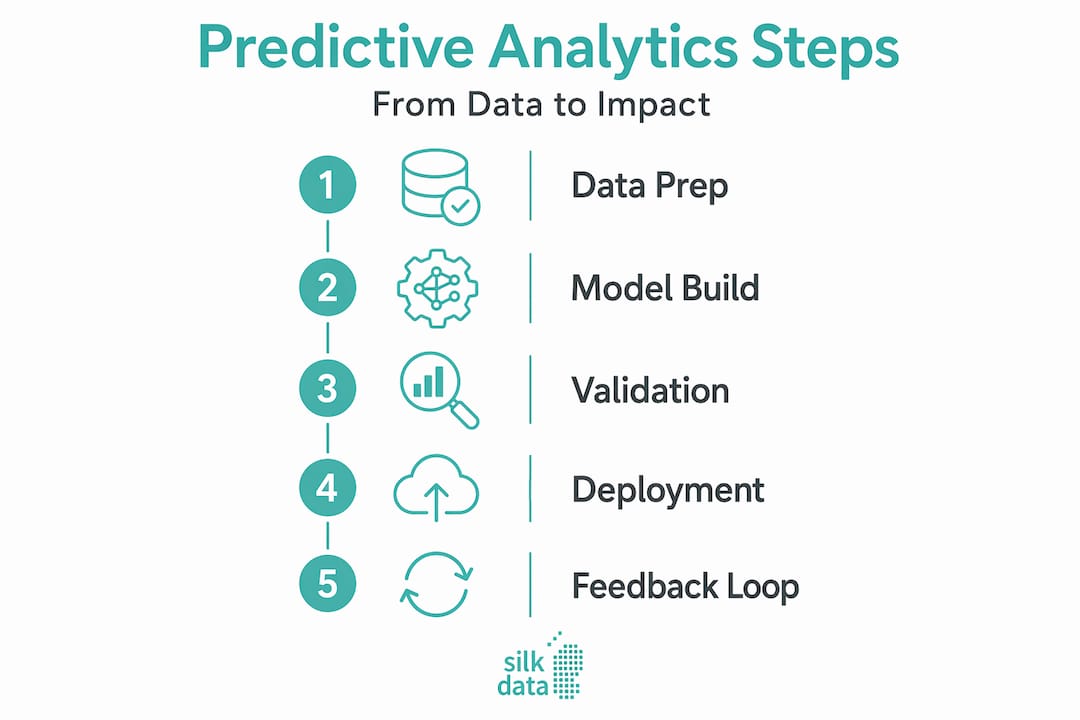
Here is the core workflow most successful projects follow:
- Define the business problem. Be specific. "Improve sales" is too broad. "Reduce customer churn in the top revenue tier by 15% over six months" gives a model something to optimize against.
- Gather and integrate data. Pull from CRM systems, transactional databases, web behavior logs, and third-party sources. The richer and more relevant your data, the stronger your model's foundation.
- Clean and prepare data. Remove duplicates, handle missing values, and normalize formats. This step consumes 60 to 80 percent of project time and is the most underestimated.
- Select your modeling approach. Choose between classification, regression, time-series, or ensemble methods depending on the outcome type you are forecasting (more on this in the next section).
- Train and validate the model. Split your data into training and test sets. Train the model on historical data, then measure how accurately it predicts outcomes on data it has never seen.
- Deploy the model into production. Integrate predictions into existing workflows, dashboards, or automated decision systems so teams can act on outputs in real time.
- Monitor, retrain, and improve. Models degrade over time as real-world conditions change. Operational foundations like data quality, integration pipelines, and feedback loops are what separate models that sustain accuracy from those that quietly become liabilities.
How much data is enough? As a working rule, classification problems need at least 1,000 examples per class for stable training; regression problems need several thousand observations with meaningful variance in the target variable; time-series forecasting needs at minimum two full seasonal cycles. These are floors, not ceilings - more data usually helps, but only when it is relevant and clean. If you do not have these volumes today, start collecting and labeling deliberately while the rest of the foundation is built.
| Stage | Common tools | Key success factor |
|---|---|---|
| Data preparation | SQL, Python, ETL pipelines | Completeness and consistency |
| Modeling | Scikit-learn, TensorFlow, AutoML | Feature relevance |
| Deployment | APIs, cloud platforms, BI tools | Real-time integration |
| Monitoring | MLOps platforms, dashboards | Drift detection and retraining |
Pro Tip: Build your feedback loop before you deploy, not after. Define how predictions will be compared to actual outcomes from day one. This single practice dramatically shortens the path to a reliable, high-value model.
Explore predictive analytics services and advanced analytics approaches to understand how full-cycle deployment is managed at scale.
Predictive Modeling Methods: Choosing the Right Approach
Once you understand the workflow, the next critical step is selecting the right modeling approach to match your business needs. Common predictive modeling approaches include classification, regression, time-series forecasting, and ensemble methods, and each maps to a different type of business question.
Here is a practical breakdown:
- Classification: Predicts a category, such as "will this customer churn: yes or no?" Widely used in fraud detection, credit scoring, and lead qualification.
- Regression: Estimates a numeric value, such as forecasted revenue or expected demand volume. Essential for pricing models and demand planning.
- Time-series forecasting: Analyzes data ordered by time to predict future values, such as weekly sales, energy consumption, or stock levels. Critical for supply chain and financial planning.
- Clustering: Groups similar customers, products, or events without a predefined label. Useful for market segmentation and anomaly detection.
- Ensemble methods: Combine multiple models to improve accuracy and robustness. Techniques like random forests and gradient boosting consistently outperform single models in complex business scenarios.
| Method | Best for | Example use case |
|---|---|---|
| Classification | Binary or multi-class outcomes | Fraud detection, churn scoring |
| Regression | Continuous numeric predictions | Revenue forecasting, pricing |
| Time-series | Temporal patterns | Demand planning, financial forecasting |
| Clustering | Grouping without labels | Customer segmentation |
| Ensemble | Complex, high-stakes predictions | Risk management, recommendation engines |
Good matching between method and problem is not just a technical decision. It is a strategic one. A well-chosen model reduces time to value, while a mismatch creates rework and erodes confidence in analytics across your organization.
A note on metrics. For classification, look at precision (how often positive predictions are correct) and recall (how often actual positives are caught), not just accuracy - which is misleading on imbalanced data like fraud or churn. For regression, MAE and RMSE expressed in business units are usually more interpretable than R². For time-series, MAPE is intuitive in executive reporting but can mislead near zero values. When reviewing a model's results, ask which metric is being tracked and why - not just "how accurate is it."
Pro Tip: Start with the simplest model that could plausibly solve your problem. A well-trained regression model often outperforms a complex neural network when your dataset is small or your business context is well-structured. Complexity should follow necessity, not excitement.
See how prototyping predictive models shortens the path from concept to validated solution. And for context on how analytics ROI in marketing connects modeling choices to revenue outcomes, the patterns are consistent and instructive.
Critical Success Factors and Challenges in Predictive Analytics
After selecting your modeling approach, understanding the real-world success factors and pitfalls will help ensure you capture true business value. Most failed analytics projects do not fail because of algorithmic weakness. They fail because of organizational and operational gaps.
Key success factors:
- Data quality: Garbage in, garbage out. Inconsistent, incomplete, or biased data produces unreliable predictions, regardless of model sophistication.
- Cross-functional integration: Models must connect to the systems and teams that act on predictions. A model sitting in a data scientist's notebook creates zero business value.
- Governance and monitoring: Model degradation is real. Data drift, concept drift, and changing business conditions can silently reduce accuracy over time without monitoring in place. Mature teams track at least three signals in production: data drift (inputs shifting), model drift (outputs shifting), and concept drift (the relationship between them changing). Open-source tools like Evidently AI, or commercial platforms like Arize and WhyLabs, handle this without a from-scratch build.
- Stakeholder alignment: Decision-makers need to trust and understand model outputs. Explainability is not optional in regulated industries or high-stakes decisions.
Common pitfalls to avoid:
- Treating predictions as certainties rather than probabilistic guidance
- Ignoring feedback loops once a model is live
- Underinvesting in data preparation relative to modeling
- Failing to define success metrics before building the model
"Predictive accuracy has an inherent limit when relevant features are unmeasured or unobservable; some error is irreducible." This is important: your job is not to eliminate uncertainty, but to quantify it and make better decisions within it.
Operationalizing analytics demands governance, explainability, and bias monitoring from the start, not as afterthoughts. Pair these disciplines with advanced analytics guidance to build processes that sustain accuracy over time.
Pro Tip: Assign a "model owner" in the business, not just in IT. This person is responsible for monitoring real-world outcomes against predictions and flagging when retraining is needed. Ownership drives accountability, and accountability drives value. See more on data-driven growth strategies that embed this principle from day one.
Practical Applications: How Predictive Analytics Drives Business Value
Now, let's see how these principles translate into real-world impact across different industries. Predictive analytics is a core driver of digital transformation, enabling organizations to shift from reactive to proactive decision-making at scale.
High-impact use cases by industry:
- Retail: Demand forecasting reduces stockouts and overstock, directly improving margins and customer satisfaction. E-commerce analytics strategies show how product recommendations and dynamic pricing lift conversion rates significantly.
- Finance: Fraud detection models score transactions in milliseconds, blocking suspicious activity before it processes. Credit risk scoring improves loan portfolio quality and reduces default rates.
- Healthcare: Predictive models flag patients at risk of readmission, enabling proactive intervention and reducing costly hospital stays.
- Supply chain: Predictive maintenance forecasts equipment failure windows, allowing scheduled downtime instead of costly emergency repairs.
- Marketing: Customer churn models identify at-risk accounts weeks before cancellation, giving retention teams time to act with personalized offers.
A structural advantage links most of these use cases: small accuracy improvements compound at scale. A churn model that catches 5% more at-risk customers, a fraud model that stops 2% more fraudulent transactions, or a demand forecast that cuts stockouts by 3% can translate to seven-figure annual impact in a mid-sized company. The question for leaders is rarely whether predictive analytics works - it is whether the organization is set up to act on the predictions consistently.
Why Most Predictive Analytics Efforts Fail - and How to Get It Right
Here is an honest perspective drawn from working closely with organizations across industries: the technical modeling phase is rarely where value is lost. The gap is almost always in the "last mile" from prediction to business action.
Many organizations invest heavily in building sophisticated models, only to have those models sit unused because teams do not trust the outputs, cannot interpret them, or have no clear workflow for acting on them. This is what practitioners call the "model graveyard" problem. Technically successful. Operationally irrelevant.
Many organizations focus on building models but struggle to operationalize them into reliable decision flows. Governance, monitoring for bias and drift, and explainability are what ultimately determine business value, not the algorithm's complexity.
The organizations that consistently extract value from predictive analytics share three traits. First, they treat model deployment as a business process change, not a technical handoff. Second, they invest in change management so that frontline teams understand and trust the outputs they are asked to act on. Third, they build structured feedback loops that continuously improve model accuracy and business relevance over time.
Starting smaller than you think necessary is also wise. A focused, well-deployed model that solves one problem reliably does more for analytics culture than an ambitious project that stalls in production. Build the proof points, then scale.
Operationalizing predictive analytics well means designing for adoption from the very beginning, not engineering it in afterward.
Accelerate Your Predictive Analytics Journey
Armed with knowledge, here's how you can fast-track your organization's predictive analytics journey. Silk Data brings over a decade of experience and a team of more than 65 full-time engineers to help organizations move from data potential to measurable business impact. Our Predictive Analytics Services cover the full cycle, from defining the business problem and preparing data to deploying, monitoring, and scaling production-grade models. Explore our Predictive Analytics Case Studies to see real outcomes across retail, finance, marketing, and beyond. For organizations ready to build a broader analytical foundation, our Data Science and Advanced Analytics practice offers strategic consultation, custom model development, and integration with your existing technology stack. Let's build something that works.