
Most boards know AI matters. Fewer can say where their AI budget went last year and what it changed. What gets called an AI strategy is often a scattered set of pilots, vendor trials, and one-off automations. They never add up to enterprise impact. This guide breaks down what an AI strategy actually is, what it should contain, and where most of them quietly fall apart.
Key Takeaways
| Point | Details |
|---|---|
| Strategy is a portfolio, not a tool list | An AI strategy ranks problems by value and feasibility, then commits budget. It is not a vendor shortlist. |
| Data work dominates the cost | In our projects, 50-65% of the effort sits in data preparation. Plan for that, or the timeline slips. |
| Deployment mode is a decision, not a default | Automation, augmentation, and supervision serve different risks. Picking the wrong one breaks trust faster than a bad model. |
| Governance is jurisdictional | EU AI Act, GDPR, FERPA, and NIST AI RMF map to different geographies and data types. Mixing them blurs accountability. |
| Simpler beats fancier | If SQL or a classical ML model solves it, an LLM is overkill. Start small, prove value, then scale. |
What an AI Strategy Actually Is
An AI strategy is a written plan that says which business problems AI will solve, in what order, with what data, under what governance, and with what budget. Everything else is a wish list.
The MIT Sloan view is consistent with this: an AI strategy is an enterprise plan that ties AI work to business objectives, not a portfolio of disconnected pilots. MIT Sloan Management Review and BCG research found that companies treating AI as a strategic priority across functions are far more likely to report financial benefits than those running isolated experiments.
A real strategy does five things at once:
- Ranks problems by expected value and feasibility, and kills the rest before they consume engineering hours.
- Names an owner on the business side for every model, not just a technical lead.
- Defines the data each use case needs, who owns it, and where it can legally live.
- Picks deployment modes deliberately: full automation, human-in-the-loop, or supervised autonomy.
- Builds governance into the operating model from day one, not as a legal review at the end.
A practical starting point. Most strategies we build at Silk Data start with one workshop and one document. The workshop is a half-day with the executive sponsor and the two or three line-of-business owners closest to the candidate use cases. The document is a one-page scoring of every candidate against business impact, data readiness, deployment risk, and time-to-value. Anything below the cut line goes on a watchlist with a re-review date. The workshop does not need consultants; the document does need someone who has run this before and can ask the questions that surface uncomfortable answers in the room.
There is a trade-off to acknowledge. A tight strategy slows down the first six months. Teams cannot just spin up pilots. In return, the second year stops looking like a graveyard of half-finished projects. Most leaders we work with accept that trade once they have seen the alternative.
The Five Components That Actually Matter
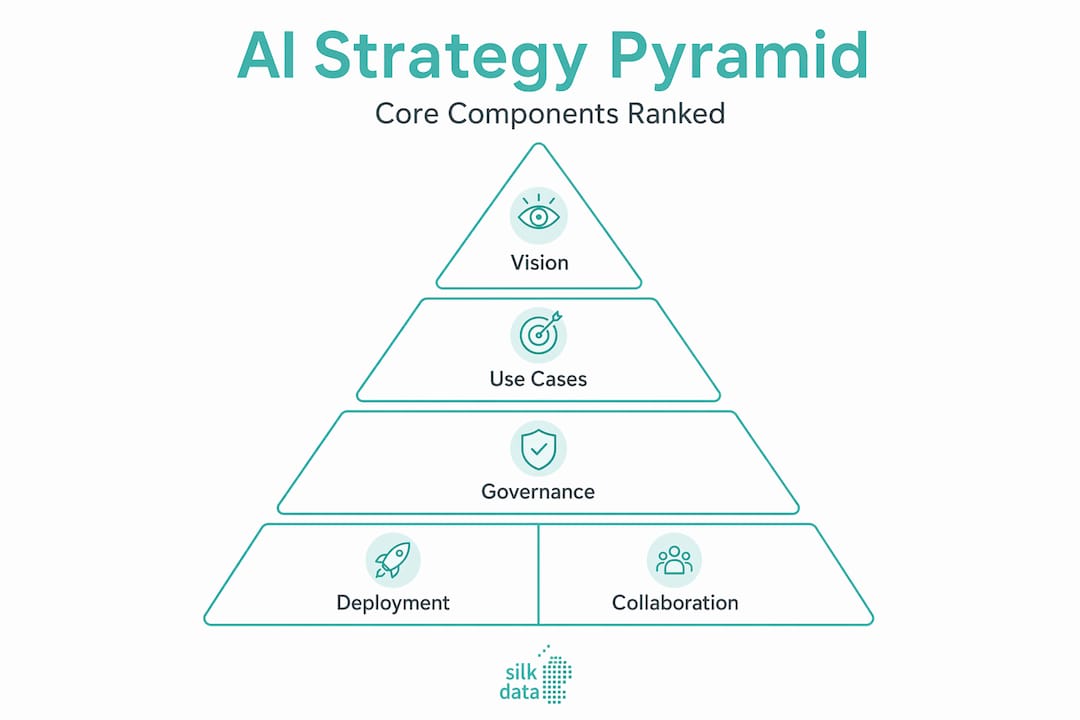
A workable AI strategy covers five domains. Skip one, and the gap shows up later as cost, risk, or shelfware.
- Use case selection. Rank candidates on business impact and feasibility. The high-impact, high-feasibility quadrant funds itself. Everything else goes on a watchlist.
- Technology fit. Match the method to the problem. A churn forecast usually wants gradient boosting, not a fine-tuned LLM. Our machine learning case studies show where classical ML still beats anything generative for structured prediction.
- Data foundations. Define ownership, quality bars, access rules, and retention before training starts. In a click-prediction project we ran at 0.1-0.5% CTR, resampling did not save us. We needed tens of millions of records. Data volume is a strategy question, not a technical detail.
- Governance and responsible AI. Bias controls, monitoring, audit trails, and named accountability. Compliance frameworks should be picked by jurisdiction, not stacked together (see the governance section below).
- Operating model. Who decides what gets built, who maintains it, who shuts it down. Without this, every model becomes someone else's problem the moment its champion changes job.
Polina Volodina, our AI Advisor, usually frames the first conversation around one question. If this model worked perfectly tomorrow, which line of the P&L would move and by how much? If no one can answer, the use case is not ready for the strategy yet.
Where the Budget Really Goes
Most vendor proposals make modeling look like the main event. In practice, it is a small slice of the work. Across 200+ projects, our effort distribution looks like this:
| Phase | Share of effort | What happens here |
|---|---|---|
| Metric definition | ~10% | Translate the business goal into something measurable. |
| Data preparation | 50-65% | Sourcing, cleaning, labeling, joining, validating. The honest majority of the cost. |
| Modeling | 10-15% | Training, evaluating, tuning. |
| Deployment and integration | 10-15% | APIs, monitoring, hand-off to the business owner. |
| Monitoring | Continuous | Drift, fairness, performance. Never ends. |
The headcount mirror of this budget split is often invisible to leadership. A team with five ML engineers and one data engineer will produce the inverse of what's needed - fast modeling, slow everything else. The pattern that ships projects: two to three data engineers per ML engineer for the first 6-9 months, then rebalancing once the data foundation stabilizes. If the team you've been pitched looks heavy on modeling talent and light on data work, the timeline has already slipped - the team just doesn't know it yet.
If a vendor proposal puts 60% on modeling and 10% on data, treat it as a warning. We have seen budgets blow up because data work was scoped as a side task. A predictive analytics project for large animal farms found a single record listing one animal at several dozen tons. That kind of error sits in real data. It shapes the result more than any algorithm choice.
Choose the Deployment Mode Deliberately
The deployment mode decides how AI changes the work itself. Pick the wrong one and adoption stalls, regardless of model accuracy.
| Mode | What AI does | Human role | Best fit | Watch out for |
|---|---|---|---|---|
| Automation | Runs the task end to end | Reviews exceptions | High-volume, low-ambiguity tasks: invoice extraction, CV parsing | Silent failures when input distribution shifts |
| Augmentation | Recommends, ranks, drafts | Decides | Clinical triage, underwriting, hiring shortlists | Over-reliance on the recommendation over time |
| Supervision | Acts autonomously within bounds | Monitors, intervenes | Fraud alerts, anomaly detection, supply chain signals | Alert fatigue and unclear escalation paths |
An example from our AI resume screening project: unstructured CVs become structured records, the model ranks candidates and drafts interview questions, but the recruiter still decides who moves forward. That is augmentation, not automation. We could have automated the rejection step. We did not. The cost of a wrong rejection is asymmetric: candidates lost, brand damage, and discrimination risk.
Yuliya Marazenko, who leads our LLM and NLP implementations, puts it bluntly in scoping calls. The question is not what the model can do alone. It is what it should do alone given the cost of being wrong.
Governance by Jurisdiction, Not by Checklist
Responsible AI is not a brand. It is a stack of decisions about data, accountability, and law. The frameworks that matter depend on where you operate and what data you touch.
- EU AI Act applies to AI systems placed on or used in the EU market. It classifies systems by risk tier and sets obligations for each. Relevant if you sell into the EU or use AI on EU users. The official EU AI Act text is the source to read before scoping a high-risk use case.
- GDPR governs processing of personal data of people in the EU. Any AI system trained on or scoring personal data sits inside it.
- NIST AI RMF is voluntary US guidance for managing AI risk. Useful as an internal scaffold even outside the US.
- FERPA applies to US student education records. Relevant for EdTech, not for adjacent consumer products.
- ICO is the UK data protection regulator. Read it for UK personal data use, not for general AI engineering questions.
Mixing these in one bullet list, the way many strategy decks do, hides which rule actually binds you. Pick the frameworks your geography and data type require, then build the controls. The technical controls sit on a separate layer. Bias testing, drift monitoring, audit logs, and named ownership should run on every model regardless of jurisdiction.
A useful internal rule: every deployed model has a business owner, a technical owner, a decommission criterion, and a monitoring dashboard. If any of those is missing, the model is not in production. It is in limbo.
Agentic AI: When to Plan, When to Wait
Agentic systems do not just predict or generate. They take multi-step actions: read a document, call an API, write a record, trigger a workflow. The strategic question is not whether to use them. It is when.
The case for planning now: governance and data infrastructure take longer to build than the agent itself. If you wait until the technology is everywhere, you will deploy without controls.
The case for waiting: error compounding. In a single-shot model, a bad output is one bad output. In a five-step agent, a 90% step-level accuracy means roughly 59% end-to-end success. That math does not work for finance, healthcare, or legal workflows yet.
A reasonable middle path:
- Build the data plumbing and access controls now. Those investments pay off even without agents.
- Run agentic pilots only on reversible, low-stakes workflows: internal research, drafting, triage.
- Define explicit guardrails: which tools the agent can call, what it cannot touch, when a human must approve.
- Treat the agent like a junior employee. Audit the work for the first quarter. Do not give it sign-off authority on anything that matters.
Where Most AI Strategies Quietly Fail
The pattern behind failed AI programs is usually organizational, not technical. Three failure modes show up again and again.
The C-suite delegates AI to IT. When AI is treated as an infrastructure project, priorities follow the org chart instead of the P&L. The strategy never gets the political weight to shut down low-value pilots or push budget toward boring-but-valuable work like data quality.
Deployment is scoped as a launch, not a behavior change. A model that ships into a workflow no one redesigned ends up bypassed. Adoption depends on how the work itself was reorganized, not how good the model is.
Governance is added at the end. Retrofitting bias testing, audit logs, and ownership onto a deployed model takes longer than building them in. It also surfaces problems publicly instead of privately. By then, trust is the casualty.
The model has a champion, not an owner. A champion gets it built. An owner keeps it alive. The two are often the same person at launch and different people six months later, when the champion has moved on to the next initiative and the owner has not been formally named. The model keeps running until something breaks; then everyone discovers that "ownership" was implicit. Fix: make ownership transfer an explicit milestone with a calendar date, not an organic process.
Yuri Svirid, our CEO, frames the lesson from 30+ years across EdTech and FinTech this way. The model is the easy part. The hard part is deciding who owns the decision the model is making, and being honest when the answer is "we should not be making this decision with a model at all."
How Silk Data Fits In
If the picture above looks familiar, the next step is usually narrowing the strategy into two or three concrete use cases worth a proof of concept. That is the work we do.
Our team is 65+ engineers across Warsaw and Krefeld, led by PhD-level technical staff. We have shipped 200+ projects and run 32 long-term builds from scratch. Useful starting points depending on where you are:
- AI consulting for feasibility, roadmap, and build-vs-buy reviews when you are still scoping the strategy.
- AI proof of concept for a ~3-month scoping-to-prototype cycle on a single use case.
- On-prem LLM integrations when your data cannot leave the perimeter, including the local LLM setup we built for a marketing agency.
We will tell you when SQL is enough and a model is overkill. That conversation tends to save more budget than any tooling decision downstream.