
Written by the Silk Data engineering team based on over a decade of production AI deployments across FinTech, HealthTech, EdTech, publishing, and retail, including regulated systems for financial services and healthcare where responsible AI practices were engineering constraints from day one.
Responsible AI development is one of the most consequential topics in technology today, yet it is routinely misunderstood. Most organizations treat it as a set of ethical aspirations printed in a policy document. The reality is far more demanding: a working responsible AI framework requires engineering controls, budget allocation, and enforcement mechanisms, not just principles on a slide. Ethical AI principles are the "why"; responsible AI is the "how" to enforce those values through engineering, governance, and measurable controls. For professionals building or deploying AI systems, that distinction is not semantic. It determines whether your AI actually behaves as intended when it encounters real users, edge cases, and regulatory scrutiny.
The 2026 context sharpens this distinction. In May 2026, the EU Digital Omnibus on AI agreement deferred Annex III high-risk obligations to December 2027, widening the compliance runway but not changing the design principles. Frontier AI labs matured their responsible scaling frameworks: Anthropic's Responsible Scaling Policy through multiple iterations, OpenAI's Preparedness Framework with structured capability tiers, and Google DeepMind's Frontier Safety Framework. These are not just internal governance documents. They are increasingly cited by regulators, procurement teams, and institutional investors as reference points for what responsible AI at scale should look like.
US federal policy shifted toward deregulation, moving compliance weight onto state-level laws: the Colorado AI Act (developer and deployer duties for high-risk AI), California AB 2013 (training data transparency, effective January 2026), Illinois SB 3499 (automated employment decision restrictions), and Utah's AI Consumer Protection Act. For US-operating organizations, mapping state exposure is now as important as federal-level readiness. Any responsible AI framework you commit to today needs to hold up across all three of these currents, not just the one closest to your headquarters.
What Is Responsible AI Development: Core Principles
Responsible AI is an operational framework built around six foundational pillars, and a mature AI governance function typically maps its work directly to these pillars. Understanding each one clarifies why responsible AI development demands more than good intentions.
- Fairness. The system produces consistent outcomes across demographic groups. In practice, this means defining fairness metrics before training, testing against protected attributes, and blocking releases with harmful bias through automated fairness testing cadences. In our AI resume screening work for a talent acquisition firm, calibrating the model to avoid demographic bias in candidate ranking was as much engineering work as building the extraction pipeline itself. Fairness constraints move earlier in the sprint, not later.
- Transparency and explainability. Stakeholders, including users, regulators, and internal teams, can understand how a model reaches its decisions. Model cards, which detail objectives, training data, performance metrics, and limitations, are now legally required for high-risk AI under the EU AI Act.
- Accountability. There is a named person or team responsible for every AI system's behavior. A named executive with budget authority and board-level reporting is critical to enforce this at scale.
- Privacy. Data used in model training and inference respects user consent, data minimization principles, and applicable regulations such as GDPR or CCPA. For the full compliance surface, our leader's guide to data privacy in AI deployment covers where privacy translates into architectural choices.
- Safety. The system is tested for failure modes before deployment and monitored continuously for drift, adversarial inputs, and unexpected behavior.
- Human oversight. Meaningful human review is built into decision workflows, especially where outcomes affect people's rights, finances, or health. Our work on a digital avatar assistant for cancer treatment support is a case in point: the system provides information and answers, but every clinical pathway decision routes back to a qualified oncologist. AI compresses the information gathering. Humans keep the decision.
Responsible data governance underpins all six pillars. Without trustworthy, well-documented data pipelines, fairness and privacy controls cannot function regardless of how sophisticated the model is. For a deeper look at how AI governance and compliance intersect in practice, it is worth reviewing the specific obligations that apply to your sector.
How to Operationalize Responsible AI Across the Lifecycle
Principles become real through a defined lifecycle, which is where responsible AI implementation either holds up or collapses. Effective responsible AI deployments follow four stages: identifying potential harms, measuring impact, mitigating risk, and continuous monitoring. Each stage carries specific technical requirements.
- Identify harms. Conduct structured impact assessments before committing to a use case. Map out who could be harmed, under what conditions, and with what severity. Red teaming, where adversarial testers deliberately try to break the system, surfaces failure modes that standard testing misses.
- Measure impact. Define quantitative metrics for fairness, accuracy across subgroups, and safety thresholds. Without baseline measurements, you cannot demonstrate compliance or detect degradation over time.
- Mitigate risk. Apply technical controls such as differential privacy, output filtering, and constraint-based model training. Document every control, its rationale, and its limitations in a model card or system card.
- Monitor continuously.Responsible AI treated as a one-time checklist fails. Data distributions shift, usage patterns change, and societal expectations evolve. Automated monitoring with documented incident response procedures keeps accountability active post-deployment. Reference sources such as the AI Incident Database and the annual Stanford AI Index Report provide industry-wide patterns to test your own monitoring against. If your system exhibits behavior that mirrors a documented public incident, you want to catch it in your logs before regulators or reporters do.
The regulatory context reinforces this lifecycle approach. The EU AI Act mandates conformity assessments for high-risk applications. The NIST AI Risk Management Framework provides a structured process for categorizing and managing AI risks. ISO 42001 certification signals a mature, internationally recognized responsible AI management system to regulators and clients alike.
The 2026 addition: agentic AI governance and General Purpose AI compliance. The four-stage lifecycle above was designed for models that receive inputs and return outputs. Agentic AI systems, which take actions in the world (send emails, execute trades, book appointments, modify files), introduce a fifth failure surface: unintended action cascades. Frontier labs have published responsible scaling policies precisely because agent autonomy amplifies the cost of any governance gap. For any deployment involving agent tools, add explicit controls: action allowlists, reversibility checkpoints, budget caps on tool calls, and mandatory human approval for high-severity actions. On the compliance side, the EU AI Act General Purpose AI Code of Practice published in May 2026 gives frontier model providers and downstream deployers a structured template for evidencing compliance, with first enforcement actions expected from August 2026. A model that hallucinates is a bug. An agent that takes irreversible action based on a hallucination is an incident.
August 2026 as an immediate milestone. For organizations working with general-purpose AI models, August 2, 2026 marks the second anniversary of EU AI Act entry into force and the point at which the General Purpose AI Code of Practice published in May 2026 begins to inform regulatory expectations of both providers and downstream deployers. If your organisation embeds a foundation model into a customer-facing product, you have downstream deployer obligations even without training a model yourself. Documentation of intended use, human oversight design, and post-market monitoring plans are the practical artifacts regulators will request. Building them retroactively is significantly more expensive than building them into the initial deployment cycle.
| Key takeaway | Details |
|---|---|
| Lifecycle is non-negotiable | Responsible AI requires structured stages from harm identification through continuous monitoring, not a single pre-launch review. |
| Documentation drives compliance | Model cards and system cards are both best practice and legal requirements under the EU AI Act for high-risk systems. |
| Accountability needs an owner | A named executive with board-level reporting is the governance structure that makes all other controls enforceable. |
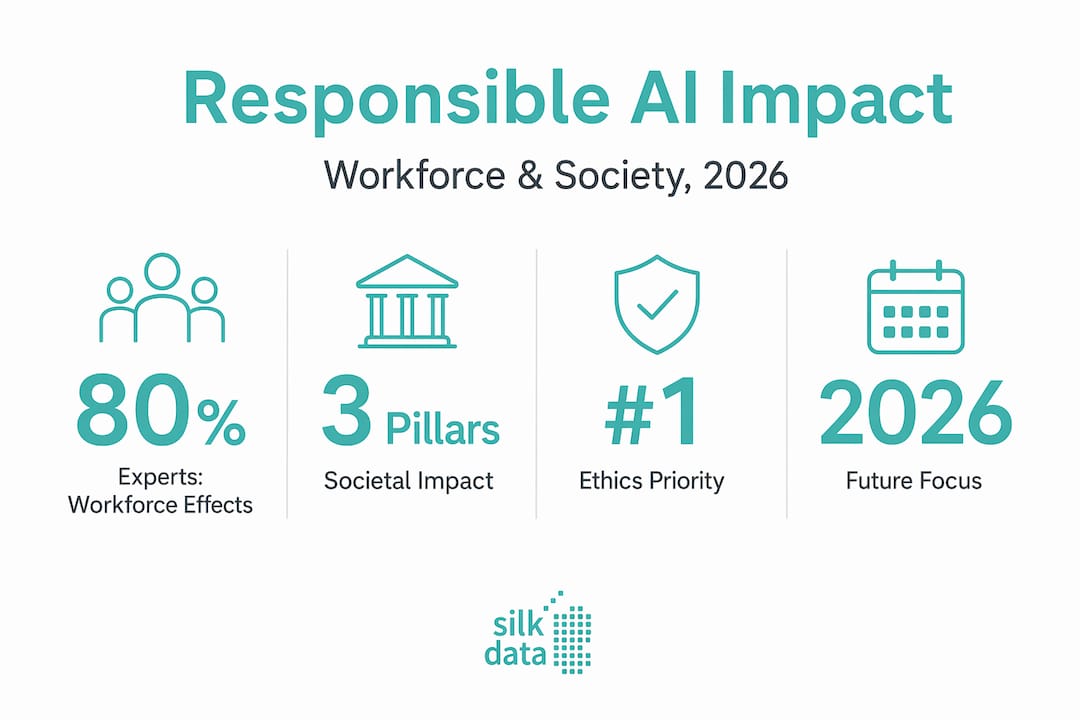
| Workforce effects are in scope | Nearly 80% of experts say workforce impacts should factor into deployment decisions and be communicated transparently. |
| Standards provide proof | ISO 42001 and NIST AI RMF give organizations a recognized framework to demonstrate responsible AI maturity to external stakeholders. |
How Does Human Oversight Work in Responsible AI Systems?
Human oversight takes three distinct forms: human-in-the-loop, where a person reviews and approves each AI output before it takes effect; human-on-the-loop, where a person monitors AI decisions and can intervene; and human-in-command, where humans set the parameters and rules but do not review individual outputs. Choosing the right pattern for each use case is one of the most consequential decisions in responsible AI development.
High-stakes applications demand strong oversight. A credit-decisioning model, a clinical diagnosis tool, or a hiring screen all carry consequences severe enough to require human-in-the-loop controls. Lower-stakes applications, such as content recommendation or inventory forecasting, may operate effectively with human-on-the-loop monitoring combined with automated anomaly alerts.
The risk of over-automation is underappreciated. When AI systems make consequential decisions at speed without human review, errors compound before anyone notices. Agentic AI systems demand strict risk containment strategies that prioritize governance and reversibility over deployment efficiency. This is especially relevant as organizations deploy autonomous AI agents in customer service, financial trading, and healthcare triage.
- Document which oversight pattern applies to every AI system in your portfolio.
- Assign designated reviewers with clear escalation paths before go-live.
- Review oversight patterns whenever the system's use case, user population, or risk profile changes.
One trade-off worth naming: human oversight has real cost. A human-in-the-loop review adds latency measured in minutes rather than milliseconds, and reviewers need training, tooling, and shift rotation. That cost is not a reason to skip oversight. It is a reason to match the oversight pattern to the risk level, so the cost lands where it earns its keep. In our AI-based document analysis work for financial services, we designed the workflow so specialists review only flagged exceptions, not every extraction. Speed and control coexist when the boundary between them is drawn deliberately.
Vendor Governance When You Deploy Third-Party AI
Most enterprise AI systems in 2026 are not built from scratch. They embed foundation models (OpenAI, Anthropic, Google, Mistral), specialised APIs (translation, transcription, extraction), and increasingly agent frameworks (LangChain, LangGraph, CrewAI). Each of these dependencies inherits responsible AI obligations you may not have designed and cannot fully audit.
Four practices we consistently see separate mature vendor governance from procurement theatre.
- Model provider transparency requirements. Before signing, require written disclosure of training data sources, safety evaluation results, known limitations, and refusal patterns. If the provider cannot produce a model card or system card, that answer is your answer.
- Contract clauses on training data usage. Default assumption: any input to the vendor API can be used for model retraining unless the contract explicitly says otherwise. Enterprise API tiers typically block this. Consumer tiers usually do not. Verify this in writing for every vendor, every year.
- Change notification protocols. Foundation model providers push model updates that can change behaviour materially. Written notice before major version changes, with the right to test before rollout, is a standard enterprise-tier request in 2026. Providers who cannot support this belong in low-risk workflows only.
- Compliance flowthrough. If your product is subject to EU AI Act deployer duties, and you embed a foundation model, your compliance depends on the provider's documentation. This has to be contractually binding, with the provider committing to produce Article 26-compliant artifacts on request.
The pattern is straightforward: vendor governance is not one-time procurement diligence. It is an ongoing operational discipline that touches contracts, engineering, and compliance quarterly. For a deeper look at the procurement scorecard we use in advisory work, see our guide to evaluating AI vendors for enterprise.
Incident Response for AI-Specific Failures
Traditional incident response frameworks (built for security breaches, service outages, data leaks) do not fully cover the failure modes AI systems produce. Three AI-specific patterns require dedicated response playbooks.
Model drift cascades. A model that performed within tolerance last quarter has degraded silently. The signal often appears in downstream business metrics before it appears in model performance dashboards, because monitoring focuses on aggregate accuracy while the drift concentrates in specific subgroups. Response requires the ability to pause inference, roll back to a previous model version, and re-establish baseline metrics on current data. This is significantly more operationally complex than a service outage rollback.
Hallucination and confident-error incidents. A generative system produces an output that is plausible, confident, and wrong, and that output propagates into a customer decision, a public communication, or a downstream automated action. Response includes containment (blocking further outputs with similar signatures), impact assessment (which downstream decisions were affected), notification (customers, regulators, and where applicable, insurers), and forensics (why the model produced this output and whether the same failure pattern exists elsewhere in the system).
Prompt injection and jailbreak incidents. An adversarial input causes the system to bypass its safety controls, leak sensitive information, or execute unauthorised actions. Increasingly common as agentic systems get deployed with tool access. Response requires immediate revocation of the affected agent's tool permissions, forensic reconstruction of the injection vector, and update of input filtering rules across the fleet.
The common thread: AI incidents are rarely resolved by patching one bug. They typically require model changes, prompt or system prompt updates, monitoring recalibration, and communication with affected parties. Building incident response drills into your operational rhythm before an incident occurs is significantly cheaper than learning the workflow during your first crisis.
How Does Workforce Impact Factor Into Responsible AI?
Responsible AI development extends beyond the model itself. Nearly 80% of experts emphasize that workforce effects, including skill atrophy, displacement, and AI brain fatigue, should factor into deployment go/no-go decisions. Yet most organizations treat workforce impact as a change management problem rather than a governance requirement.
This framing is a mistake. When workers rely on AI for tasks they previously performed themselves, their proficiency in those tasks degrades. In high-stakes domains like radiology, legal review, or financial analysis, that degradation has systemic risk implications. Responsible AI governance must account for this explicitly.
The societal dimension is equally concrete:
- Transparent communication. Employees affected by AI deployment deserve clear, honest information about what the system does, what it decides, and where humans retain authority.
- Proactive governance. Deployment timelines should include workforce assessment checkpoints, not just technical acceptance tests.
- Stakeholder engagement.Community-led audits involving those affected by AI systems are an emerging best practice for maintaining both trust and accuracy in impact assessment. This is close in spirit to how bias surfaces in editorial content. In our automatic news analysis platform, the goal is not to remove bias from source material (that is not the AI's job), but to surface differences between sources so readers can see them explicitly. The pattern generalises: responsible AI often means making the disagreement visible, not hiding it under a single confident answer.
- Compliance alignment. Workforce impact disclosures are increasingly expected by regulators and institutional investors conducting ESG assessments.
The importance of responsible AI, properly understood, includes these dimensions. An AI system that performs well technically but displaces workers without mitigation or communication has failed a material governance standard.
Where Responsible AI Actually Breaks Down
The gap between an enterprise responsible AI policy document and its actual engineering practices is almost always larger than anyone admits. The failure mode is not bad intentions. It is the absence of budget, ownership, and enforcement mechanisms. Teams write principles, hold an ethics workshop, and return to shipping models under the same velocity pressures that existed before. Fairness testing gets skipped when sprint timelines tighten. Incident response plans exist as documents, not practised drills.
Responsible AI becomes real only when it is embedded in the definition-of-done for every model release, not treated as a parallel track. That means automated fairness gates in CI/CD pipelines, model cards as mandatory release artifacts, and a named executive who can actually stop a deployment. Embedding ethics directly into system design, including automated enforcement of fairness constraints and role-based human-in-the-loop triggers, is what separates organizations that practise responsible AI from those that describe it.
The cost question, addressed honestly. In our advisory work, responsible AI controls typically add 15-25% to a typical AI project budget when built in from the start, and 40-70% when retrofitted after launch. That gap is not a scare number. It reflects the practical reality that fairness testing infrastructure, model documentation pipelines, monitoring systems, and incident response tooling are cheaper to build once alongside the model than they are to bolt on after the model is in production. The compliance cost is real either way. The choice is whether it lands as a manageable line item in the initial budget or as an emergency remediation project a year later. In regulated sectors, we typically see the 15-25% investment fully recovered within the first eighteen months through reduced regulatory friction, faster procurement approval, and lower incident response burden.
Yuliya Marazenko, Head of AI Implementation at Silk Data, on the pattern that separates the two:
"The organizations we see navigate this well treat responsible AI as an evolving governance culture, not a compliance milestone. They budget for it, staff for it, and revisit it every time their data, use cases, or regulatory environment changes. On our side, the discipline shows up in small operational choices: model cards written before deployment, not after; a named executive who can hold a launch; fairness tests that run automatically on every model version. When those small choices become routine, the policy document starts to reflect reality instead of aspiration."
How Silk Data Supports Responsible AI in Practice
Two situations bring organizations to us when responsible AI moves from policy document to production requirement.
The first is when a project sits in a high-stakes domain where the cost of a bad decision is measured in regulatory action, reputational damage, or human harm. Our work spans regulated environments where governance was a constraint from day one: AI-based document analysis for financial services, a plagiarism detection system for education, and a digital avatar for cancer treatment support. Each of these required the responsible AI disciplines above (fairness testing, human oversight, documented data lineage, audit trails) to be treated as engineering deliverables, not policy artifacts.
The second is when a project involves sensitive data that cannot leave the client perimeter. Our on-prem LLM deployment for a marketing agency is one example: client briefs stayed inside the agency's infrastructure, which closed a whole class of compliance risk that no API contract can neutralise. For a decade-long partnership with a German publishing house, the archive never left the client's servers. Data residency, when it is real, has to be architectural, not contractual.
Silk Data has spent over a decade on AI projects across FinTech, HealthTech, publishing, EdTech, and retail. If you are ready to move from responsible AI as a principle to responsible AI as a shipped, monitored, auditable system, that conversation is what our AI consulting practice is for. For related depth, see our work on custom AI development, data science and advanced analytics, and NLP services.
Responsible AI Readiness Checklist
Before your next AI project reaches production, verify:
- Named executive owner with authority to stop a launch
- Model card documented and reviewed before deployment
- Fairness metrics defined per demographic group and tested automatically
- Human oversight pattern chosen deliberately (in-the-loop / on-the-loop / in-command)
- Data lineage documented for training and inference
- Incident response procedure defined and practised, not just written
- Compliance mapping completed for applicable frameworks (EU AI Act, GDPR, sector-specific rules)
- Workforce impact assessment completed if the system replaces human tasks
- For agentic systems: action allowlists, reversibility checkpoints, budget caps defined