Expert’s Thoughts

"Modern supply chains are more complex and interconnected than ever, making them vulnerable to disruptions, delays and escalating costs. Traditional management methods, relying on historical data and manual processes, are no longer sufficient to navigate this landscape. This is where artificial intelligence emerges as a transformative force. By integrating AI, businesses can shift from a reactive posture to a proactive, predictive, and self-optimizing model.
This blogpost will explore the core technologies powering the AI-driven supply chain, its most impactful applications, and the practical steps to harness its power for unparalleled efficiency, resilience, and competitive advantage."
Yuri Svirid, PhD. — CEO Silk Data

Why do Companies Need AI in Supply Chain?
Modern supply chains face numerous complexities, spanning global networks and dealing with disruptions and rising costs at the same time. Traditional management approaches struggle to keep pace and become increasingly inefficient for business growth. Through that, artificial intelligence and supply chain integration have become essential.
Companies need AI in the supply chain to transform their operations into proactive optimization. Implementing an intelligent AI supply chain delivers crucial advantages:
- Predictive decision-making. You’ll be able to move beyond historical data to anticipate demand fluctuations, potential disruptions and maintenance needs before they impact operations.
- End-to-end optimization. You can automate and fine-tune every process, from inventory management and procurement to logistics and last-mile delivery, maximizing efficiency and minimizing losses.
- Enhanced resilience. Build a self-correcting supply chain that can dynamically reroute shipments, adjust inventory levels and mitigate risks in real-time.
- Significant cost reduction. Identify saving opportunities through optimized routing, reduced stockouts and overstocks, and automated back-office processes.
The Core Technologies Powering the AI Supply Chain
The transformative power of AI in the supply chain is delivered through the interconnection of the most prominent technologies. These are the fundamental building blocks that create an intelligent, self-optimizing AI supply chain ecosystem capable of learning, adapting and operating with minimal human intervention.

Machine Learning
This is the brain of the AI supply chain. ML algorithms analyze vast amounts of historical and real-time data to identify patterns and predict future outcomes. In practice, this means forecasting demand with high accuracy, predicting potential delays from weather or traffic, and anticipating machine maintenance needs before a breakdown occurs. This moves the entire supply chain process from a reactive posture to a strategically predictive one.

Natural Language Processing
NLP allows the AI in the supply chain to understand and process human language. It automates the extraction of critical insights from unstructured data sources like supplier emails, customer reviews, news reports and logistics documentation. This enables the system to automatically detect shipment delays mentioned in an email, and process contracts, ensuring that valuable textual information is considered during decision-making processes.

Computer vision
Using cameras and image recognition, computer vision automates quality control by inspecting products for defects on assembly lines. In warehouses, it can read labels, track inventory and manage stock levels by ‘seeing’ what's on shelves. It also optimizes loading processes by identifying and counting packages, reducing errors and manual labor in logistics.

Robotic process automation
RPA acts as the digital workforce of artificial intelligence and supply chain. It automates high-volume, repetitive rule-based tasks such as data entry, purchase order processing and invoice reconciliation. By integrating RPA, companies free human employees for more strategic work while ensuring back-office operations are faster, more accurate and available 24/7.
Key Applications of AI Across the Supply Chain

Demand Forecasting and Planning
One of the key problems that every supply department wants to solve through AI implementation is inventory optimization. Stockouts and overstock reductions are vital and require accurate demand forecasting.
The advanced AI agent will allow to move beyond traditional spreadsheets to predict demand with high accuracy by leveraging the predictive analytics capabilities. An AI can easily analyze hundreds of internal and external variables, such as seasonality data, promotions info, market trends, weather and traffic conditions, new regulation policies, and much more.
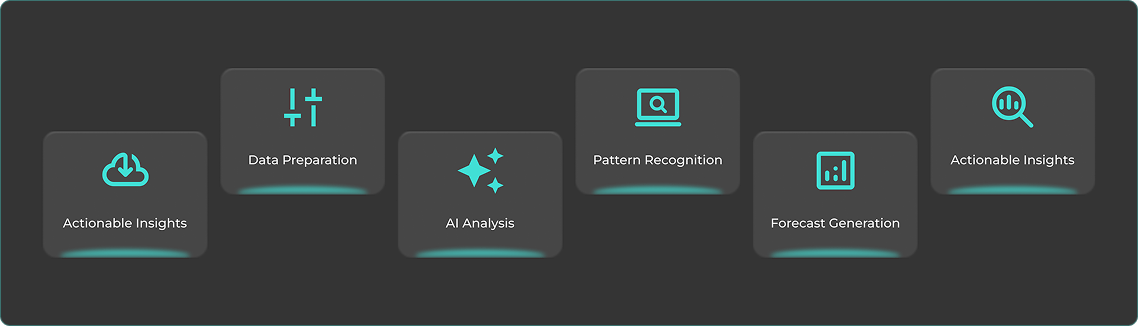
The following scheme demonstrates standard process of AI-based demand forecasting:
Intelligent Warehousing and Automation
Another use case lies in reduced labor costs, minimization of warehousing errors, and improved space utilization.
Apart from AI-powered robots set for picking and packing, the supply department can leverage computer vision capabilities for automated inventory checks, and ML algorithms for optimization of warehouse layout and slotting.
Smarter Logistics and Transportation Management
The same can be referred to optimization of supply transportation and logistical costs. Practices like intelligent monitoring and analysis, can lead to dynamic route optimization and reduced costs, regarding lower fuel consumption, improved on-time delivery, and enhanced customer satisfaction.
Predictive Maintenance
In the context of equipment and machinery maintenance, AI agents can use IoT sensor data from vehicles and warehouse facilities to predict failures before they happen. This is achieved by permanent monitoring and ML-based analytics and recommendations.
Such an approach will minimize unplanned downtime, extend asset life and reduce overall maintenance costs.
What are the Benefits of Using AI in Supply Chain and Logistics?
Integrating artificial intelligence into supply chain operations is a present-day necessity for competitive advantage. The benefits of implementing an AI supply chain extend far beyond simple automation, creating a ripple effect of efficiency, resilience and value across the entire organization. By leveraging AI in supply chain management, companies can transform their logistics from a cost center into a strategic asset.
As a confirmation for such industry’s intentions, IBM in cooperation with Oxford Economics conducted an Institute for Business Value study among over 2000 business operation and automation executives. 90% of them reported that they will incorporate AI assistance into their supply chain workflows in 2026.
Such statistics is the result of possible benefits the AI in supply chain can provide.

Benefit 1. Efficient Demand Forecasting
Traditional forecasting methods often fail to predict market demands in both short-term and long-term perspectives. AI supercharges this process by analyzing a multitude of internal and external data points, reducing the overall time spent on demand forecasting operations. For example, Idaho Forest Group used AI-powered improvements and reduced forecasting time from 80 hours to 15. The key highlights of AI usage in demand forecasting are the following:
- Multi-factor analysis. Apart from sales history, you can incorporate weather patterns, social media trends, economic indicators, and competitor activity.
- Hyper-accurate predictions. Machine learning models continuously learn and improve their performance, drastically reducing forecast errors and minimizing both stock-outs and overstock situations.
- Granular insights. You can forecast demand at regional or store level, enabling precise inventory placement.

Benefit 2. Proactive Risk Management and Resilience
An AI in the supply chain also acts as an early warning system, identifying potential disruptions before they cause costly delays. This is how technology copes with the task:
- Real-time disruption monitoring. The AI agent can be set to continuously scan for risks like geopolitical events, weather disasters, port congestion and supplier financial status.
- Simulate ‘What-If' scenarios. It can model the impact of potential disruptions and automatically generate pre-approved contingency plans.
- Dynamic rerouting. Automatic rerouting of shipments in real-time helps to avoid delays, ensuring continuity of operations.

Benefit 3. Maximizing Efficiency and Optimizing Costs
AI prevents inefficiencies across the entire logistics network, leading to substantial cost savings. There’s only a brief list of means that can be performed with the usage of fine-tuned AI agent and lead to better efficiency.
- Optimized inventory. Maintain optimal stock levels, reducing the amount of excess inventory while still ensuring product availability.
- Smarter logistics. You will be able to calculate the most efficient shipping routes and select optimal carriers to cut transportation costs.
- Automated warehousing. Combine the capabilities of AI-guided robots and computer vision systems to accelerate picking and packing, reducing labor costs and errors.
Benefit 4. Enhancing Customer Satisfaction and Loyalty
A responsive and reliable supply chain ensured by well-considered implementation of AI agent is a powerful tool for building brand loyalty. It is achieved by:
- Perfect order fulfillment. The AI can ensure customers get the right product, at the right time, every time.
- Transparent tracking. It provides accurate, real-time delivery updates and can assist in proactive communication with any potential delays.
- Ensured personalized experiences. Business gets an opportunity to tailor delivery options and inventory offerings based on individual customer preferences and purchase history.
In addition, AI usage can help in dealing with customer requests and complains through intelligent analysis of their requests. For example, one of the AI solutions developed by Silk Data can process and analyze customer email requests and define their style and tone. The AI agent identifies client’s intention and can provide them with all the necessary details or transfer the request to a dedicated human specialist. Such practice significantly reduces the time of request processing and allows to provide quick response, ‘fine-tuned’ for certain clients' intentions.
Steps of Preparing Supply Chain for AI Implementation
Successfully integrating AI in the supply chain requires comprehensive planning and a real strategic approach. Rushing the process can lead to wasted investment and sabotaged projects. A methodical, step-by-step preparation is key to building a future-proof and intelligent AI supply chain that delivers tangible value.
- 1
Aligning AI with Business Goals
The first and most critical step is to ensure your AI initiative directly supports overall business objectives. To do so, the number of steps is required.
- Identify key challenges. Find specific pain points you want to solve from the very first stage. It can be a need to reduce transportation costs, improve on-time delivery or minimize stockouts.
- Define clear KPIs. Establish measurable performance indicators to track the success of your AI initiatives.
- Secure executive authority. Ensure that leadership is aligned and committed, and there is always a person responsible for providing the necessary resources and mitigating AI implementation and maintenance problems.
- 2
Assessing Readiness and Gaps
An objective assessment of your business’s current state is essential for planning a realistic implementation roadmap for artificial intelligence and supply chain integration. The process may include the execution of the following steps.
- Data audit. Examine the quality, quantity, and accessibility of the data required for proper AI operations. Even the most advanced AI models require clean, structured, and integrated data to function effectively.
- Technology infrastructure overview. Review your current IT systems and determine if they can support AI tools or require upgrades and additional integrations.
- Process evaluation. Identify which existing workflows are suitable for automation or enhancement through AI.
- 3
Preparing Your Team
Your employees are the most important component of a successful AI supply chain transformation. Preparing them is one of the most essential parts.
- Fill the skills gap. Provide dedicated trainings in data literacy, AI fundamentals and new software tools employees.
- Promote cross-functional collaboration. Encourage teamwork between supply chain experts, data scientists and IT professionals.
- Redefine roles. Help team members transition from manual, repetitive tasks to more strategic, analytical responsibilities, delegating low-level operations to AI.
- 4
Get Through a PoC Project
Finally, the idea to implement AI for supply needs must receive a practical confirmation. The AI Proof of Concept is the most efficient method of achieving true results and not mere estimations. Such a project would allow to see both the beneficial and problematic aspects of AI agent’s integration without dedication of large amounts of time and money.
Conclusions
The integration of artificial intelligence is a present-day necessity for any business working with a supply chain. From hyper-accurate demand forecasting and intelligent warehousing to proactive risk management and dynamic logistics, AI encourages advanced automation throughout the entire operation cycle. The key benefits provided by its implementation are cost saving, efficiency and customer satisfaction.
Nevertheless, the implementation requires a strategic, step-by-step approach. You should align AI with clear business goals, assess readiness, and prepare your team. It’s also recommended to launch and finish the PoC project to see the practical outcomes of using advanced AI agent.
If you already made your decision, and now the only problem is bringing your ideas to life, you can ask professionals for help. Silk Data is a company with extensive experience in artificial intelligence development that has already provided solutions for numerous companies in various industries, including manufacturing and supply. Our managers and experienced AI specialists will guide you through the whole solution building cycle and bring their expertise to make the AI implementation as smooth and efficient as possible.
Would like to get an advanced AI solution for your supply chain needs? Contact our specialists!
Frequently Asked Questions
No, AI is not going to replace supply chain managers — it is going to assist them. AI will automate repetitive, data-intensive tasks like demand forecasting, purchase order processing and shipment tracking. This frees up supply chain professionals to focus on higher-value strategic work that requires human judgment, creativity, and negotiation (for example, such as managing supplier relationships, developing risk mitigation strategies and making complex tactical decisions).
No, this is a common misconception. While large enterprises were early adopters, the AI in the supply chain is now accessible to businesses of all sizes. Small and mid-sized businesses can leverage affordable, scalable solutions for specific tasks like inventory optimization, demand planning and cost analysis. Starting with a single, focused PoC project allows smaller companies to achieve a quick return on investment without the massive upfront costs once associated with artificial intelligence and supply chain technology.
Good data quality is the foundation of a successful AI supply chain. Ensuring it requires a disciplined approach.
- Start with a data audit. Identify and catalog all data sources across your supply chain.
- Establish data governance. Implement clear policies and standards for data entry, formatting and management to maintain consistency.
- Clean and integrate. Use tools and processes to regularly clean, deduplicate and integrate data from disparate systems into a single source of truth.
- Automate data collection. Wherever possible, use IoT sensors and automated data feeds to minimize manual entry errors.










Our Solutions
We work in various directions, providing a vast range of IT and AI services. Moreover, working on any task, we’re able to provide you with products of different complexity and elaboration, including proof of concept, minimum viable product, or full product development.