
By the Silk Data engineering team. Based on production AI integrations across ERP platforms, content archives, advertising backends, and agricultural databases since 2015.
McKinsey's most recent global AI survey found that 88% of organisations use AI in at least one business function, but only 39% report measurable enterprise-level EBIT impact. That gap is not a modelling problem. It is an integration problem.
This guide covers that work: adding machine learning, NLP, or predictive analytics to SAP, Oracle, mainframe, and custom platforms without rewriting them. You get five architectural patterns and the variable that decides between them, the effort split to budget for, a five-stage rollout with explicit exit gates, the failure modes that repeat, and the current EU AI Act position after the Digital Omnibus took effect in July 2026. Where a rules engine or a SQL query is the better answer, this guide says so.
Key Takeaways
- The bottleneck is integration, not model quality. Adoption is near-universal; measurable value is not.
- Five patterns cover almost every case. The deciding variable is failure isolation, not latency.
- Budget 50 to 65 percent of effort for data preparation, 10 to 15 for modelling. Proposals that invert this ratio overrun.
- The Digital Omnibus, adopted June 2026, moved standalone high-risk obligations to 2 December 2027. Article 50 transparency duties still applied from 2 August 2026.
What AI Integration with Legacy Systems Actually Involves
AI integration with legacy systems, sometimes called brownfield AI integration, means adding model-driven capability to platforms already running in production without rewriting them. The legacy system keeps the business logic and remains the system of record. The AI layer operates at the edges.
That is the principle everything follows from. The model never becomes the source of truth. It produces a score, a classification, a suggestion, or a retrieved passage, and a rule or a human decides what to do with it. The moment model output is written back as authoritative data without a validation boundary, you have coupled the reliability of your system of record to a probabilistic component. That failure costs the most to unwind.
The four things an AI layer can add
- Inference on a single record. Classify an invoice, score an application, route a ticket. Synchronous, low-latency, usually behind an API.
- Enrichment of existing records. Add a missing field, normalise an inconsistent one. Usually asynchronous, and the risk is silently overwriting good data with worse.
- Prediction over a population. Forecast demand, estimate churn, predict equipment failure. Runs on a schedule, and fails through drift nobody detects because nobody defined the baseline.
- Retrieval over unstructured content. Search contracts, archives, documentation, sitting alongside the existing keyword index rather than replacing it. Our guide on AI for unstructured data covers this pipeline in detail.
Most projects combine two: a document workflow does retrieval plus inference, a CRM programme does enrichment plus prediction. Which combination you are building tells you which patterns below apply.
Four constraints you inherit
Schema rigidity. Legacy schemas were built for transactional integrity, not for vectors, embeddings, or variable-length model output, and adding a column to a core table in a twenty-year-old ERP can mean weeks of change control. So model output usually lives in a parallel store joined at query time, and you inherit a join-consistency problem you did not have before. The same rigidity has no semantics for "completed, but low confidence", so decide explicitly whether low-confidence output commits, queues for review, or aborts.
Batch windows. Overnight jobs assume exclusive table access for a fixed period. An AI service querying those tables during the window either blocks the job or reads mid-transaction state. This is the most common reason pilots that worked in test fail in production, because test environments rarely reproduce the batch schedule. Map the batch calendar before writing integration code.
Access control models. Older platforms implement role-based access at object level; modern retrieval needs permission-aware filtering at query time, on individual records or chunks. Getting that bridge wrong means a retrieval layer that surfaces content a user was never entitled to see, which is a compliance incident rather than a bug. Relatedly, legacy APIs were sized for human-paced traffic, and connection pool exhaustion under AI load is a routine week-three discovery.
Undocumented business rules. The legacy system is still running because it encodes decades of logic nobody fully wrote down. A model trained on its outputs reproduces that logic, including the obsolete parts, and only a subject-matter expert can tell you which is which. That is why an SME belongs in the loop from week one rather than at acceptance testing.
Three decisions this forces
- Wrap it. The legacy system exposes a usable interface, the latency budget allows a synchronous hop, and a human or rule validates the output. Most new AI features on existing platforms land here.
- Queue it. The transaction path is production-critical and cannot absorb added latency or an extra failure dependency. Enrichment and scoring go asynchronous. Slower, dramatically safer.
- Leave it alone. The system is scheduled for replacement, data quality sits below the threshold where any model produces reliable output, or a threshold and a query already handle the decision. Recognising this case early is the cheapest win in the programme.
Five Architectural Patterns and When to Use Them
| Pattern | Latency | Coupling to legacy | Pros | Cons | Best for |
|---|---|---|---|---|---|
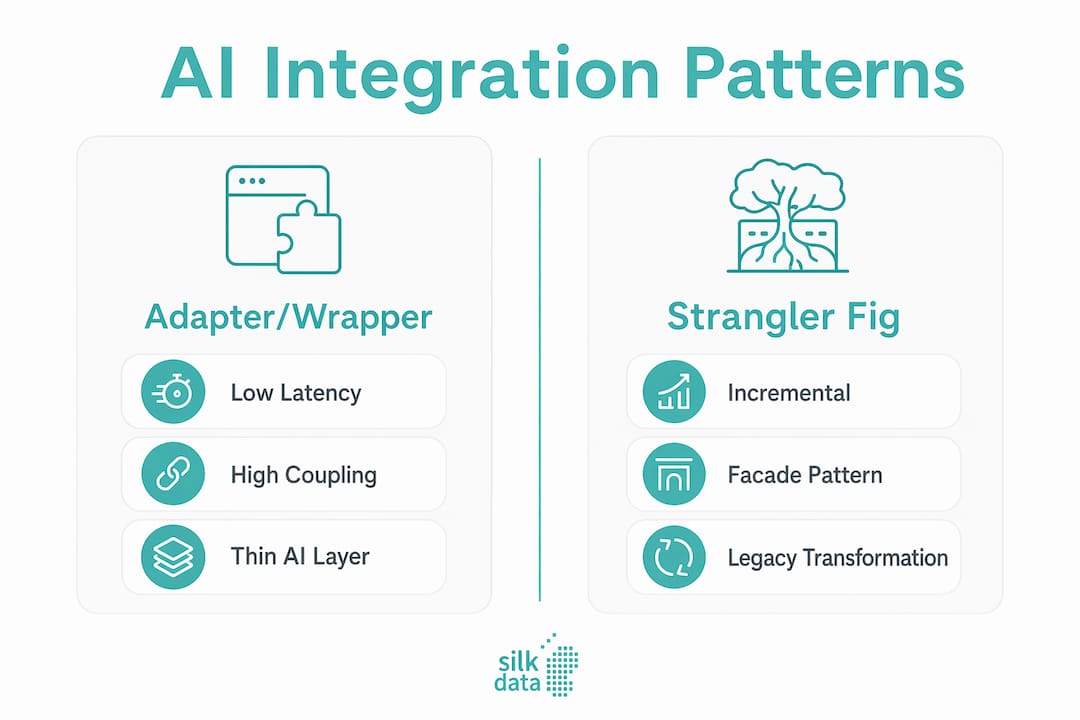
| Adapter / Wrapper | Low | High | Cheapest to build | Failure in AI layer can break the legacy call | Thin AI features over existing APIs |
| API Gateway + microservice | Medium | Low | Clean isolation, easy to roll back | Extra hop, more infrastructure | New AI features alongside legacy |
| Sidecar | Low | Medium | Per-service enrichment without central bottleneck | Operational overhead grows with service count | Containerised legacy workloads |
| Async Queue Enrichment | High (offline) | Very low | Model failures never block the transaction | Not for real-time UX | Batch enrichment, scoring, classification |
| Strangler Fig facade | Variable | Decreasing over time | Gradual migration with built-in fallback | Long timeline, dual-system complexity | Replacing parts of a legacy platform |
How to read this table
The column that decides most production outcomes is coupling, not latency. Coupling is a proxy for failure isolation: it answers what else stops working when the AI layer goes down. Latency is a user-experience constraint you can usually negotiate. Failure isolation is an availability constraint you cannot.
First, the blast radius. What breaks if the AI component errors, returns nothing, or takes thirty seconds? If the answer touches a revenue-generating transaction, a regulatory filing, or a safety path, coupling must be low, which eliminates Adapter regardless of cost. If the answer is a stale internal dashboard, the cheapest pattern wins. The build-cost gap between Adapter and Gateway is a few engineering weeks; a coupled failure in a transaction path is an incident.
Second, the latency budget. Real-time decisions, under roughly 300 milliseconds end to end, rule out queues and favour Adapter or Sidecar. Anything tolerating minutes should default to Async Queue Enrichment, the only pattern where a model failure is invisible to the business process. Before accepting a real-time requirement, ask how fast the decision it feeds is actually made: many tolerate five minutes, which moves the design into the safest pattern in the table.
Third, how much you trust the output. A model with a validated baseline and a tested rollback path can sit closer to the transaction. A model in its first month sits behind a queue or a facade with a human in the loop. Trust is earned by observability, not benchmark scores.
Two notes on the table. These patterns combine in production, and gateway plus queue is the workhorse pairing: split traffic by risk class and one AI service supports both a real-time interface and a nightly enrichment job. And Strangler Fig is a migration programme rather than a runtime topology, so inside one you are still choosing between the other four for every capability you move. Where a legacy schema is too inconsistent to query directly, an LLM can normalise field names without changing the source, as in our 6M-image search system built on ElasticSearch, with schema validation at the facade boundary since LLM middleware is not deterministic.
Before any cutover, run shadow traffic: send a copy of production requests to the AI layer and compare output to the legacy response. Schema mismatches, batch-window collisions, and latency spikes surface here rather than in user reports.
The Data Problem No One Budgets For
Data preparation takes 50 to 65 percent of total effort in our project breakdowns. Modelling takes 10 to 15. That ratio rarely matches what proposals show clients at the start.
Legacy data is messy in ways AI exposes faster than dashboards ever did: the same entity carries three different keys across three systems, and sensor readings, manual entry, and imported third-party data share a single column.
An example from our predictive analytics work for large animal farms. While predicting survival probability, data preparation surfaced records showing individual animals weighing several dozen tons. The algorithm did not catch it, because the algorithm trusted the input. A subject-matter expert reading the same rows caught it immediately. Data quality matters more than algorithm choice, and domain expertise has to sit inside the loop rather than reviewing at the end.
Governance: The Current EU AI Act Position and What to Actually Do
If your compliance calendar still has 2 August 2026 marked as the date full high-risk obligations arrive, that is out of date, and so is most guidance written before summer.
The Digital Omnibus on AI received final Council approval on 29 June 2026, after the European Parliament endorsed it on 16 June by 423 votes to 57 with 174 abstentions, and entered into force in July. The practical effect:
- Obligations for standalone high-risk systems under Article 6(2) and Annex III now apply from 2 December 2027 rather than 2 August 2026. Systems placed on the EU market before that date fall under them only if substantially modified afterwards.
- High-risk AI embedded in products already regulated under Annex I, such as medical devices, machinery, and vehicles, moves to 2 August 2028.
- Article 50 transparency obligations were not deferred and applied from 2 August 2026: telling users they are interacting with a chatbot, labelling deepfakes, marking synthetic content in machine-readable form.
- Generative systems on the market before 2 August 2026 have a three-month grace period, so the Article 50(2) marking obligation binds them from 2 December 2026.
- The Omnibus also added new prohibited categories, extended the GDPR legal basis for certain bias-detection processing, and expanded the AI Office's enforcement role.
The deferral is a scheduling change, not a substantive one. The obligations are unchanged, and technical documentation, risk management, and human oversight take longer to build than the runway suggests. Design to the December 2027 requirement and treat the extra time as budget relief rather than permission to defer the architecture.
Beyond the EU AI Act, match the framework to the jurisdiction. GDPR applies whenever personal data is processed, and training data, inference logs, and embeddings all count. The NIST AI RMF is voluntary US guidance whose four functions, Govern, Map, Measure and Manage, work as an engineering checklist well outside the US. ICO guidance is the UK reference and treats compliance as a repeatable process rather than a one-time assessment. FERPA applies if you touch US student records. Our guide to data privacy in AI deployment maps the full surface.
On the engineering side, four controls cover most production risk. Tag every AI component in an inventory, including ones business units bought without telling IT. Define accuracy, latency, and distribution metrics before deployment, because you cannot detect drift in something you never measured. Give every production model a tested fallback to the previous version or the pre-AI legacy path. And log inputs, outputs, and decisions for any model affecting a customer-facing outcome, since reconstructing that retroactively is not possible.
Heavy governance slows iteration; light governance scales risk faster than value. For high-risk EU workloads, lean heavy. For an internal classification tool, lean light and document the reasoning. Our guide on responsible AI development covers the operational side.
"In production, the model you can monitor and roll back is worth more than the model with two more accuracy points. Observability is not a feature you add at the end. It decides whether the project survives its first incident." - Yuliya Marazenko, Head of AI Implementation, Silk Data
How to Stage the Rollout
Start with a workload where the AI informs a human decision rather than automating one. Each stage has an explicit exit gate, and the discipline that matters is refusing to advance without meeting it.
Stage 1: Scoping and dependency map. Two to four weeks, driven by how much institutional knowledge is documented rather than held by individuals. Three artefacts have to exist before anyone writes integration code, and each is produced here.
The dependency map covers every service, data store, API, and batch job the AI layer will touch. The service-model decision constrains everything after it: SaaS (Azure AI Foundry, AWS Bedrock) starts fastest but limits where data sits and how tightly you can pin model versions, PaaS buys fine-tuning control, on-prem keeps data inside the perimeter and costs most in engineering time. For regulated EU workloads that is not only a cost question, since data governance, human oversight, and post-market monitoring are easier to satisfy on-prem than on a shared endpoint. In a local LLM deployment for a marketing agency, the deciding factor was not model quality but that client data could not leave the perimeter under their contract. The third artefact is a named business owner, plus a written baseline of how the decision is made today, including its current error rate.
Exit gate: the owner can state the decision in one sentence and you have a measurable baseline, without which "the model works well" is unfalsifiable. Discovering here that the data does not exist, is not retained long enough, or cannot legally be used is a good outcome: finding it in week three costs a fortnight, in month six it costs the programme. For the upstream discipline that makes all of this hold, see our guide on data strategy for AI.
Stage 2: Proof of concept. About three months, most of it on data rather than modelling. Outputs: a prototype against a real production snapshot rather than synthetic data; a data-quality assessment listing what was cleaned and what remains broken; performance measured against the Stage 1 baseline; an integration design naming the chosen pattern; a production cost estimate including inference, monitoring, and human review time. Exit gate: a go or no-go decision against criteria written down at the stage's start. Roughly a third of the time the honest answer is no-go, and a PoC producing a defensible no-go has done its job. What kills this stage is scope creep into productionisation.
Stage 3: Shadow deployment. Four to eight weeks, and at least one full business cycle including a month-end if the process has month-end behaviour. The AI runs alongside the legacy path and its output is logged but used for nothing. Outputs: a disagreement analysis showing where model and current process differ and which was right; latency and resource consumption under real load; the production data characteristics the PoC snapshot did not contain. Exit gate: the disagreement rate is understood, not merely measured. An unexplained 8 percent divergence blocks the gate even when aggregate accuracy looks acceptable, because you cannot predict which 8 percent will matter.
Stage 4: Incremental traffic shift. Six to twelve weeks. Move 5 percent, then 20, then 50, then full, holding each step at least a week. At every checkpoint verify output distribution against the shadow baseline, latency at the 50th and 95th percentiles rather than the mean, human override rate as the earliest signal that staff have stopped trusting the output, and downstream error rates in the legacy system itself. Rollback triggers get defined before the first step and are not negotiated during an incident. Exit gate: a full business cycle at 100 percent with no trigger fired and override rate stable or falling. What kills this stage is advancing on schedule rather than on evidence.
Stage 5: Production with scheduled governance review. Quarterly by default, monthly where data volumes are high. Each review covers drift against the deployment baseline, the AI inventory updated rather than confirmed, the incident log including near-misses, whether the business decision itself has changed, and a retraining decision with reasoning recorded. A review also runs off-calendar on an upstream schema change, a new data source, a model version change, a regulatory reclassification, or the named owner changing role. That last trigger is the most underrated: ownership transitions are where governance quietly lapses, because the incoming owner inherits a system whose original assumptions were never written down for them.
Common Failure Modes
Overinvesting in model choice, underinvesting in observability. Six weeks benchmarking models, one week on monitoring. Six months later outputs have changed and nobody can say when or why, because there is no baseline. Model selection is a legible, bounded, satisfying engineering task; observability is neither. Monitoring belongs in the definition of done for the first deployment, not a follow-up ticket. Given a choice between two accuracy points and a working rollback path, take the rollback path.
Treating governance as a checklist, and the shadow AI that follows. The inventory gets built once during the first compliance push, then nobody updates it, and eighteen months later a regulator asks for the current model register and there is none. Meanwhile business units have connected AI tools to production data through whatever integration the vendor offered, and nobody in IT knows those systems exist. Both are the same failure: inventory maintenance has no natural owner, and the sanctioned route to a governed capability is slower than the credit-card route. Attach inventory updates to change management so the register updates as a side effect of work that already happens.
Solving with machine learning what SQL would solve. If a query and a threshold produce the right answer, that is the answer. A model adds training data requirements, monitoring, drift management, and explainability work, all permanent obligations. The cause is scoping the project as an AI project rather than as a problem, constraining the solution space before analysis begins. Build the rules-based baseline first and measure it. We tell clients this even when it shortens the engagement.
Provider-side model version drift. You build against a hosted foundation model, the provider ships an update, and behaviour changes with no deployment on your side. Reliable prompts become inconsistent; output formats shift enough to break downstream parsing. The cause is treating a hosted endpoint as a stable dependency when it is a moving one. Pin model versions where the provider supports it, negotiate change-notification terms in the contract, and run a regression suite of representative inputs on a schedule rather than only at deploy time. Our guide to evaluating AI vendors for enterprise covers the contract side.
Giving an agent write access to a system of record. A wrong prediction is a bad suggestion; a wrong agentic action is a committed transaction other processes depend on. Agents should write to a staging table or queue, with an explicit approval step committing the change and human sign-off for high-severity actions. If an action cannot be reversed, it does not belong in an autonomous path.
"The first integration sets the pattern for every one after it. Get the governance and ownership right on project one, and project two is faster and cheaper. Get them wrong, and you keep paying for that decision for years." - Yuri Svirid, CEO, Silk Data
Where Silk Data Fits
We have spent over a decade building production AI on top of systems not designed for it: ERP platforms, content archives, advertising backends, agricultural databases, financial document workflows. Two situations bring organisations to us. The first is a use case in a regulated domain where a wrong output costs regulatory action rather than inconvenience, as in our AI-based document analysis for financial services and digital avatar for cancer treatment support, both of which required governance, traceability, and human oversight as engineering deliverables from the first sprint. The second is data that cannot leave the client perimeter, where we deploy local LLM and on-prem inference. If you are past "can AI help us?" and stuck on "how do we get a model into production without breaking what already works?", our AI consulting and AI proof of concept services are built around that question. And when SQL or a rules engine is the better answer, we say so.